



Advertising and marketing expenses are generally deductible under IRC Section 162 as ordinary and necessary business expenses in the year they are paid or incurred. The rule is straightforward for traditional media spending: television, radio, print, digital display, paid search, and out-of-home advertising are all currently deductible when the expenditure is made. The IRS has long held that advertising expenditures, even those that create goodwill or brand recognition that persists beyond the current tax year, are still currently deductible rather than capitalized, distinguishing them from tangible assets whose value clearly extends into future years.
The deductibility analysis becomes more nuanced with the formats that dominate contemporary retail and CPG marketing budgets. Influencer marketing payments represent one of the most rapidly growing areas of brand investment and also one of the most ambiguous for tax treatment. Cash payments to influencers for promoting products in defined campaigns are generally deductible as advertising expenses. However, payments for long-term exclusive arrangements, equity-like compensation structures, or arrangements that are more in the nature of endorsement contracts tied to multi-year brand licensing may require capitalization and amortization. The economic substance of the arrangement, rather than its label, determines the tax treatment.
Chart: Deductibility guide for common retail and CPG marketing expenditures.
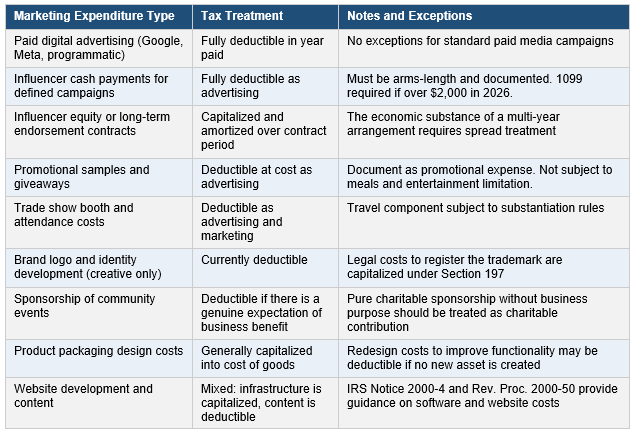
The cause-related marketing arrangement is a growing area of uncertainty for CPG brands that tie product sales to charitable contributions. When a brand pledges to donate a portion of sales proceeds to a charity, the payment to the charity is generally not deductible as an advertising expense and may not qualify as a charitable contribution either, depending on the structure. The IRS has taken the position that payments made as part of a sales promotion, where the primary purpose is to drive sales rather than charitable intent, are not deductible as charitable contributions. CPG brands using cause marketing should structure these arrangements carefully and consult with a CPA before assuming the payments are fully deductible in either category.
Bottom Line: Advertising and marketing costs are broadly deductible, but the line between a currently deductible advertising expense and a capitalized intangible asset is not always obvious. When in doubt, the determining factor is whether the expenditure creates a separately identifiable asset with a useful life extending substantially beyond the current year. If it does not, it is generally currently deductible. If it does, capitalization and amortization apply.