



When a retail or CPG business extends credit to customers and those customers fail to pay, the resulting uncollectible receivable may qualify as a bad debt deduction under IRC Section 166. The deduction is available for bona fide debts that have become wholly or partially worthless during the tax year. For businesses using the accrual method of accounting, which is most retail and CPG companies with inventory above a threshold, the bad debt deduction requires two conditions: the debt must have been previously included in income when earned, and the debt must be determined to be worthless in the current year. A cash-basis taxpayer cannot take a bad debt deduction because amounts not collected were never included in income.
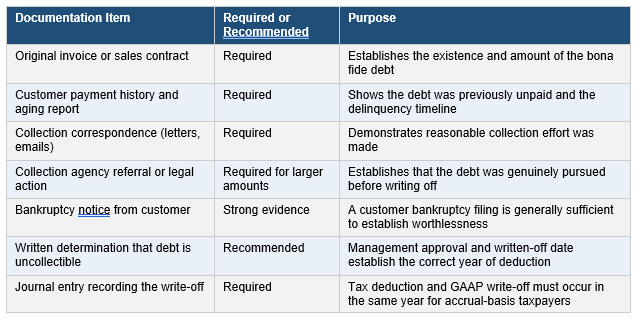
The IRS requires that the taxpayer have taken reasonable steps to collect the debt before claiming it as worthless. What constitutes reasonable collection effort depends on the amount of the debt and the circumstances. For small receivables, sending collection notices and making follow-up calls may be sufficient. For larger amounts, referral to a collection agency or attorney, filing a lawsuit, or obtaining a judgment that the debtor cannot satisfy are stronger indicators of genuine worthlessness. The year in which the deduction is claimed matters: the write-off must occur in the year the debt is determined to be worthless, not the year the customer first became delinquent.
Chart: Bad debt deduction documentation checklist for retail and CPG businesses with uncollectible receivables.
Wholesale CPG companies and retail operators with significant B2B receivables should maintain a formal allowance for doubtful accounts on their GAAP financial statements, but should note that the allowance method is not permitted for federal income tax purposes. For tax purposes, the specific charge-off method is required: only amounts that are specifically identified as worthless and actually written off the books are deductible. The GAAP allowance creates a timing difference between book and tax treatment that must be reflected in the company’s deferred tax position. Finance teams should reconcile the GAAP allowance to the tax-basis specific write-offs annually to ensure the deferred tax asset is correctly stated.
Bottom Line: The bad debt deduction is available to any accrual-basis retail or CPG business with uncollectible receivables, but the procedural requirements are real. Maintain contemporaneous documentation of collection efforts, write off the receivable in the correct year, and reconcile the book allowance to the tax specific charge-off method annually. Missing the timing by a single year forfeits the deduction.