


If you are planning to invest in your business this year, the tax rules on when and how much you can deduct have a hard deadline: December 31. The difference between buying and placing a piece of equipment in service before year end versus after is one full year of accelerated deductions. For retail and CPG operators, the purchases that qualify are broader than most people realize.
Section 179 allows businesses to deduct the full cost of qualifying property in the year it is placed in service, rather than depreciating it over time. For 2026, the Section 179 deduction limit is $1,160,000, and it phases out dollar for dollar once total qualifying purchases exceed $2,890,000. This means the deduction is designed for small and mid size businesses and phases out entirely for very large capital spenders.
Bonus depreciation under the OBBBA works differently. It is a percentage based deduction applied to the cost of qualifying property placed in service during the year. In 2026, bonus depreciation is 60%. In 2027 it drops to 40%. In 2028 it drops to 20%. If you have been waiting to make equipment purchases, the economics of waiting are getting worse each year as the bonus percentage steps down.
What Retail and CPG Operators Can Deduct Under Section 179 and Bonus
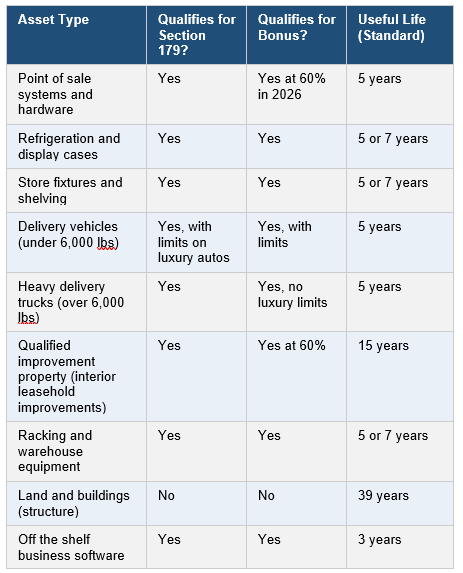
The key distinction between Section 179 and bonus depreciation is that Section 179 cannot create or increase a net operating loss. If your business is not profitable enough to absorb the Section 179 deduction, the excess carries forward to a future year. Bonus depreciation has no such limitation it can create or increase a net operating loss, which then carries forward indefinitely under current law.
For retailers making significant investments in store remodels, technology upgrades, or equipment, the placed in service rule is the most important practical deadline. Equipment that is ordered in December but not delivered and operational until January does not qualify for the current year deduction. If you are working with vendors on lead times, get the equipment installed and operational before December 31 or accept that the deduction moves to next year.
Qualified improvement property which covers interior improvements to nonresidential leased buildings is one of the most useful provisions for retail tenants. If you remodeled your store this year, added new lighting, reconfigured the floor layout, or upgraded the customer facing areas of your space, those costs may qualify for 60% bonus depreciation in 2026, with the remainder depreciating over 15 years. This is far better than the 39 year treatment that applied before this provision was clarified.
Bottom Line: Year end equipment and improvement planning is one of the most reliable tax strategies available to retail operators. Know your December 31 deadline, make sure assets are placed in service before it, and work with your CPA to maximize the combination of Section 179 and bonus depreciation that produces the best result for your specific tax position.