



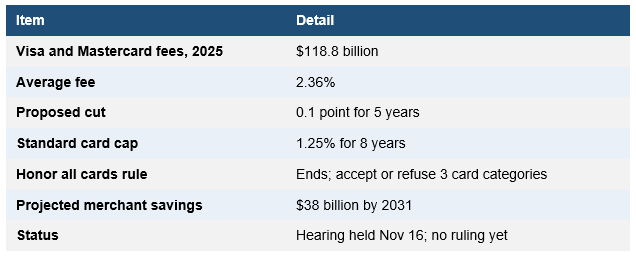
Visa and Mastercard swipe fees totaled $118.8 billion in 2025, with an average fee of 2.36%. For many retailers that’s bigger than the utility bill, and in a slow year it can be bigger than the profit. On November 16, Judge Brian Cogan in Brooklyn held the final approval hearing on the settlement meant to bring those fees down, and he did not rule. He did warn that rejecting it could lead to a “protracted process” in a case that’s already 21 years old.
The court received just over 1,000 objections, including from Walmart and the National Retail Federation. The convenience store industry argued the deal leaves fees too high on premium rewards and commercial cards, which it says make up more than 90% of the market. Visa, Mastercard, and the big banks called it a fair compromise. Plaintiffs’ experts estimate it would save merchants $38 billion by 2031. American Express and Discover aren’t part of it.
If approved, fees drop 0.1 percentage point for five years, standard consumer cards are capped at 1.25% for eight years, and the “honor all cards” rule ends. Merchants could separately accept or refuse three categories: commercial cards, premium consumer cards including rewards, and standard consumer cards. A different judge rejected an earlier $30 billion version in June 2024, so approval isn’t guaranteed.
The Swipe Fee Settlement at a Glance
Don’t wait on the judge. Pull your last three processor statements and divide total fees by total card volume. If your effective rate is above 3%, you’re likely overpaying and can negotiate now. Ask whether you’re on interchange plus or flat rate pricing, because flat rate customers may never see an interchange cut unless the provider passes it along. And during Cyber Week, remember that every point of card fees comes straight out of the margin you’re already giving up on discounts.
Bottom Line: The swipe fee deal is still in limbo, but your processing costs aren’t. Know your effective rate this month and negotiate on your own numbers, whenever the ruling comes.