



Every retail and CPG business has it: the stuff that did not sell. Last season’s colors. The product line that missed. The sizes that ran wrong. Slow moving merchandise that has been sitting in the back of the warehouse for two years. Most operators treat aged inventory as a sunk cost they have already given up on. What they do not always realize is that the write down is also a tax planning decision, and the timing of that decision matters.
Retail inventory is generally carried at cost. When merchandise can no longer be sold at or above its original cost, accounting rules and the IRS allow you to write it down to its net realizable value, which is the amount you actually expect to recover from it. That write down reduces the carrying value of your inventory on the balance sheet and flows through cost of goods sold, reducing taxable income in the year it is taken.
The key phrase is ‘in the year it is taken.’ If you sit on aged inventory hoping it will sell, you are deferring both the write down and the tax benefit. If you make the business decision to mark down or dispose of that merchandise before your fiscal year closes, you capture the deduction in the current year. This is one of the most straightforward year end tax planning tools in retail, and it is available to almost every operator.
Your Options With Aged Inventory and the Tax Impact
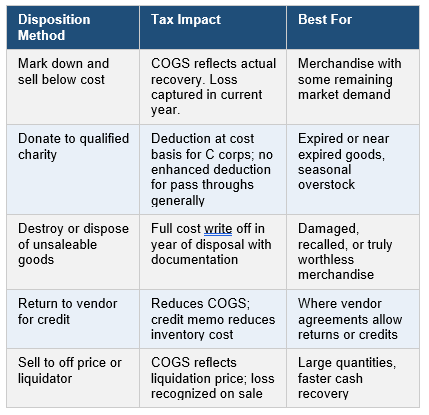
The donation option deserves a specific note for CPG brands. Under IRC Section 170(e)(3), C corporations can deduct the cost of inventory donated to qualifying organizations that use or distribute the goods to the needy at an enhanced amount up to twice the cost basis, limited to cost basis plus half of the appreciation. This provision is specifically designed to encourage food and grocery donations. A CPG company donating near date product to a food bank may be able to deduct more than just the original cost, but only if the entity is a C corporation and the receiving organization qualifies.
For pass through entities (S corporations, partnerships, sole proprietors), the inventory donation deduction is generally limited to cost basis only. That is still a real deduction, and it is often better than the alternative of destroying the goods for no deduction at all.
Timing is everything here. The write down or disposal decision needs to be made and executed before your tax year closes. Documenting that you intend to dispose of merchandise does not create the deduction. Actually disposing of it, marking it down to its recoverable value on the books, or completing the donation does. Talk to your CPA in October or November, not in March.
Bottom Line: Aged inventory is not just a margin problem. It is a tax opportunity with a deadline. Review your slow moving stock before year end, make deliberate decisions about disposition, document everything, and capture the deduction in the year the action happens.