


The federal tax code contains a series of provisions that allow employers to provide benefits to employees on a tax-favored basis, meaning the employer receives a deduction while the employee receives the benefit free of income and payroll tax. For retail and CPG employers competing for hourly workers in a tight labor market, the ability to offer tax-favored benefits represents a real compensation advantage that costs the employer less than an equivalent wage increase. Understanding which benefits qualify for favorable treatment and how to structure them correctly is one of the highest-return areas of tax planning for retail employers.
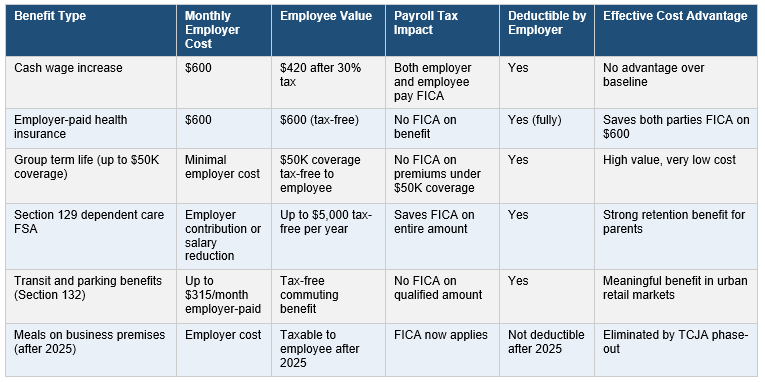
Employer-paid health insurance premiums are fully deductible by the employer as an ordinary business expense under IRC Section 162 and are excluded from the employee’s gross income under IRC Section 106. For a retail business paying $600 per month in health insurance premiums for an employee, the cost to the employer after a 25% tax deduction is $450 per month, while the employee receives $600 per month in value with no income or payroll tax consequence. The effective compensation value to the employee is actually higher than $600 because the employee would need to earn approximately $850 in pre-tax wages to net the same $600 after income and payroll taxes at a combined 30% rate.
Chart: Tax efficiency comparison between cash wages and tax-favored benefits for a retail employer, illustrating the all-in cost advantage of benefits over equivalent wages.
The Section 125 cafeteria plan is the administrative vehicle through which most employee benefit elections are processed for tax-favored treatment. A properly designed cafeteria plan allows employees to choose among a menu of qualifying benefits and to fund their elections through pre-tax salary reductions. The salary reduction reduces the employee’s taxable wages for both income tax and FICA purposes, and the employer’s FICA obligation is reduced on the same amount. For a retail business with 50 employees each reducing their wages by $2,000 per year through a cafeteria plan for health insurance and FSA elections, the employer saves approximately $7,650 in FICA annually without any additional cost. The cafeteria plan requires a written plan document and must satisfy nondiscrimination requirements, but the administrative cost is minimal relative to the payroll tax savings.
Bottom Line: Tax-favored employee benefits are not a benefit that only large employers can offer. Any retail business with at least a few employees can implement health insurance, a Section 125 cafeteria plan, and transit benefits at relatively low administrative cost. The payroll tax savings alone often justify the effort, before even considering the impact on employee recruitment and retention.