



The Employee Retention Credit was enacted under the CARES Act to provide refundable payroll tax credits to businesses that experienced a significant decline in gross receipts or were subject to a full or partial suspension of operations due to governmental orders during the COVID-19 pandemic. The program generated an unprecedented volume of claims, and the IRS has spent the past three years auditing, disallowing, and litigating a substantial portion of them. As of mid-2026, thousands of ERC claims remain unresolved, under audit, or actively contested in federal courts. For retail and CPG businesses that applied for and received credits, or that have claims still pending, the litigation landscape developing in 2026 is directly relevant to their financial exposure.
The legal standards being established in current cases address two critical questions. The first is what constitutes a full or partial suspension of business operations due to an appropriate governmental authority order. The IRS has consistently taken a narrow view, arguing that orders must have directly limited the business’s specific operations in a meaningful way, and that general COVID-related economic disruption or supply chain disruption does not qualify. Courts have varied in their application of this standard. The U.S. Court of Federal Claims case Sundancer Pools, Inc. v. United States, decided in June 2026, addressed pleading standards and causation requirements that practitioners need to understand when advising clients whose claims are based on governmental suspension orders.
Chart: ERC claim status categories and corresponding risk levels and recommended actions for retail and CPG business owners as of mid-2026.
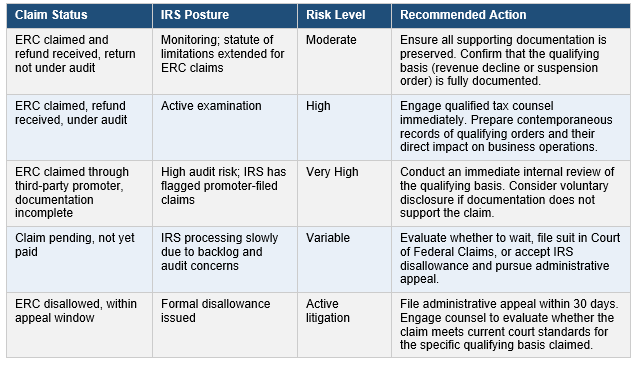
The IRS Voluntary Disclosure Program for ERC, which closed its initial window in March 2024, remains a reference point for businesses that claimed ERC on questionable grounds and wish to resolve their exposure before the IRS initiates an audit. Businesses that received ERC credits they now believe were improperly claimed should consult with qualified tax counsel about the current options for remediation, which may include filing amended returns to return the credit with reduced penalties or working through the standard audit process if the IRS initiates contact. The statute of limitations for ERC-related matters has been extended in many cases, meaning that the normal three-year window for audit does not apply with the same force to ERC claims.
The broader financial reporting implication for businesses that carry uncertain ERC claims on their balance sheet is that the ASC 450 contingency framework requires ongoing assessment of the probability of loss and disclosure of the range of possible outcomes. Businesses that recognized ERC income in prior years and are now facing audit risk should evaluate whether a contingent liability needs to be established or disclosed in current financial statements. This is particularly relevant for businesses that received significant ERC amounts and are now seeing the legal standards shift in ways that create more uncertainty about the defensibility of their original qualifying basis.
Bottom Line: The ERC is not behind you if you still have unresolved claims, ongoing audits, or documentation gaps. The court decisions being issued in 2026 are setting the legal standards that will determine outcomes for thousands of businesses. If you have not reviewed your ERC documentation against current court standards, the time to do so is now, not when the audit notice arrives.