


Business owners who receive income that is not subject to withholding, including S-corporation distributions, partnership draws, sole proprietor net income, and rental income, are generally required to make quarterly estimated tax payments to avoid an underpayment penalty. The payment due dates are April 15, June 15, September 15, and January 15 of the following year for calendar-year taxpayers. The underpayment penalty for 2026 is calculated at the federal short-term interest rate plus three percentage points, applied to the amount of the underpayment for each day it remains outstanding. As interest rates have risen in recent years, the cost of underpaying has increased meaningfully.
The safe harbor rules are the most important planning tool for managing estimated tax obligations. Taxpayers can avoid the underpayment penalty entirely by meeting one of three safe harbors. The first is paying at least 90% of the current year tax liability through withholding and estimated payments. The second is paying 100% of the prior year tax liability, which increases to 110% of the prior year liability for taxpayers whose prior year adjusted gross income exceeded $150,000. The third is the annualized income installment method, which allows taxpayers to calculate each quarterly payment based on actual income earned through that quarter rather than an annual projection.
Chart: Safe harbor comparison for a retail business owner with variable income showing the most efficient payment strategy by income scenario.
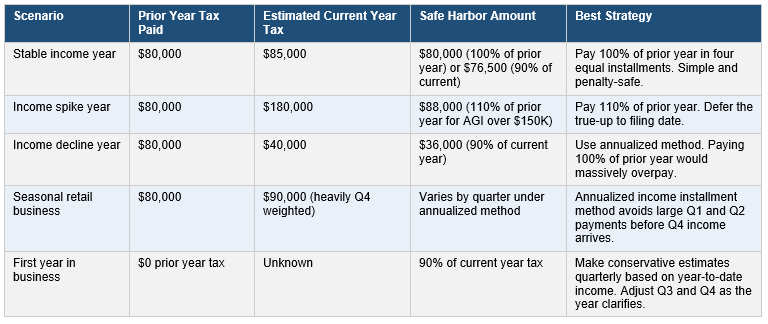
Retail and CPG business owners with highly seasonal income, which is common in holiday-driven retail, back-to-school categories, and outdoor or summer merchandise, frequently overpay in the first three quarters of the year to avoid penalty risk and then end up with a large refund after filing. This pattern is financially inefficient. The annualized income installment method under IRC Section 6654(d)(2) allows taxpayers to calculate each quarterly payment based on their actual income for the period through that quarter, annualized to an annual figure. For a retailer whose business is largely a Q4 phenomenon, this method allows minimal payments in Q1 and Q2 and a larger catch-up in Q3 and Q4 when income is actually earned, without incurring any penalty.
Bottom Line: Estimated taxes should be managed as a cash flow optimization problem, not just a compliance obligation. The safe harbor rules exist to provide certainty without requiring perfect accuracy. For retail and CPG business owners with variable or seasonal income, the annualized income installment method is almost always worth the calculation effort.