


The distinction between fixed and variable costs is one of the most important structural dimensions of a retail or CPG business, and one that is frequently glossed over in financial analysis. Fixed costs — rent, core labor, insurance, technology subscriptions, depreciation — remain relatively constant regardless of revenue volume. Variable costs — COGS, shipping, payment processing fees, sales commissions — scale directly with sales activity. The ratio between these two categories determines how a business behaves financially when revenue rises or falls.
A business with a high proportion of fixed costs has significant operating leverage. When revenue grows, margins expand rapidly because the fixed cost base is being spread over more units. But the same leverage works in reverse: when revenue declines, profitability falls sharply because fixed costs continue regardless of volume. Understanding this dynamic is particularly important for retail businesses with substantial physical store footprints, where rent and staffing create large fixed cost commitments that cannot be quickly reduced in response to a sales shortfall.
Chart: EBITDA sensitivity to a 15% revenue decline — high fixed-cost structure vs. high variable-cost structure comparison.
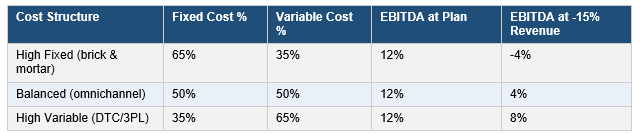
For growing businesses, the appropriate level of fixed cost commitment is a strategic decision that deserves explicit analysis. Signing a five-year warehouse lease or adding full-time headcount creates fixed cost commitments that limit financial flexibility if growth slows or reverses. Asset-light business models — which lean on 3PL fulfillment, contract manufacturing, and variable staffing — preserve flexibility at the cost of some per-unit efficiency. Neither structure is universally superior; the optimal balance depends on the business’s growth stage, financial cushion, and competitive dynamics.
Finance leaders should calculate their operating leverage ratio — the degree to which a percentage change in revenue translates into a larger percentage change in operating income — and communicate it clearly to the leadership team. A business with high operating leverage should maintain a larger liquidity buffer and plan more conservatively than a business with a more variable cost structure. The cost structure itself is a risk management decision, not just an operational one.
Bottom Line: Knowing your fixed vs. variable cost ratio tells you how your business will behave when conditions change. That is information worth having before the conditions change.