



Goodwill recorded on your balance sheet from a prior acquisition does not amortize under U.S. GAAP. Instead, it sits there until something forces you to test whether it is still worth what you paid. General Mills made this visible in fiscal year 2026, recording $1.8 billion in goodwill and intangible asset impairment charges not because the business failed, but because rising discount rates and declining market capitalization pushed the fair value of its reporting units below their carrying values.
ASC 350 requires goodwill impairment testing at least annually, or more frequently when triggering events suggest the fair value of a reporting unit may have fallen below its book value. For privately held retail and CPG operators, the most common triggers are declining revenue trends, margin compression, rising interest rates that compress valuation multiples, and loss of a major customer or distribution channel.
The test compares fair value of the reporting unit typically determined by a discounted cash flow model or market comparable analysis to its carrying value including goodwill. If carrying value exceeds fair value, the excess is an impairment charge. Importantly, goodwill impairment is not tax-deductible unless the goodwill arose from an asset acquisition rather than a stock acquisition.
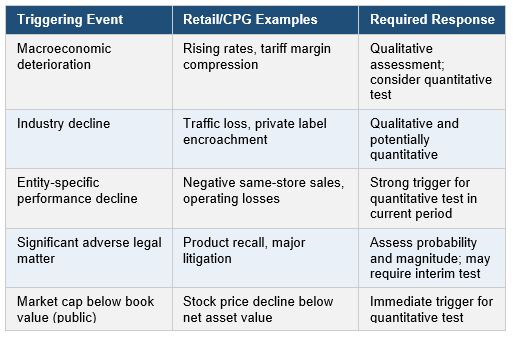
Bottom Line: Goodwill impairment is a non-cash charge that does not affect operating cash flow but does affect reported earnings and book equity. Understanding the triggers helps management, lenders, and investors interpret the charge correctly. The General Mills case is the clearest recent illustration of how a sound business can report a massive loss while producing strong cash flow.