


Asset-based lending (ABL) allows retail and CPG businesses to borrow against their inventory and accounts receivable rather than relying solely on cash flow or real estate as collateral. For a business with $500,000 in inventory and $300,000 in receivables, an ABL facility can unlock $400,000 to $600,000 in revolving credit that a traditional cash-flow loan might not provide.
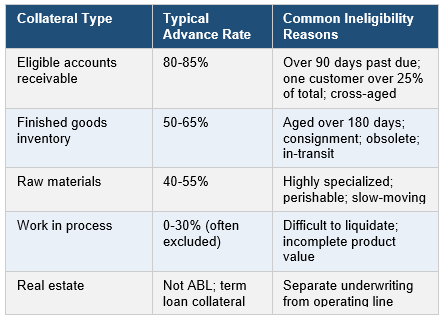
The core concept is the borrowing base: the lender advances a percentage of eligible collateral. Eligible receivables typically advance at 80-85% meaning $100,000 of qualified receivables supports $80,000 to $85,000 in borrowing. Eligible inventory advances at 50-65%, depending on whether it is finished goods, raw materials, or work-in-process.
Not all inventory and receivables are eligible. Slow-moving or aged inventory (usually over 180 days old) is excluded. Receivables over 90 days past due, concentrated receivables (one customer over 25% of total), and cross-aged receivables are typically ineligible. The lender conducts periodic audits to verify the collateral.
ABL facilities are typically revolving lines that fluctuate with collateral levels. As you sell inventory and collect receivables, you repay the line. As you buy new inventory, you draw against it again. Interest is charged only on the outstanding balance, making ABL cost-efficient for seasonal businesses with inventory buildups. This is specifically helpfull to small businesses around the holidays and peak selling periods.
Bottom Line: If your business is inventory-heavy and you’re financing operations with a working capital line that doesn’t adjust to your collateral, you may have more borrowing capacity available than your current bank is offering. An ABL line is worth evaluating if your receivables and inventory combined exceed $500,000.