



The IRS released Notice 2026-60 in late September, updating the standard per diem rates for business travel effective October 1, 2026. If your company reimburses employees or owners for travel using the high-low per diem method, and your policy still references the old rates, you are either underpaying your travelers or creating a taxable wage issue.
What Changed

How the High-Low Method Works
Instead of tracking actual lodging receipts city by city, employers can reimburse travelers using a flat per diem tied to whether the destination is on the IRS high-cost list. The full per diem covers lodging plus meals and incidentals. This simplifies bookkeeping significantly.
The per diem is considered substantiated for the amount paid so long as it does not exceed the federal rate. You still need to document the who, where, when, and business purpose of every trip. The per diem covers the dollar amount but never the fact of the trip itself.
The Accountable Plan Requirement
For per diem reimbursements to be tax-free to the employee and deductible to the employer, your plan must meet three tests:
1. Business connection. The expense must be incurred in performing services as an employee.
2. Adequate accounting. Employees must submit records showing business purpose, destination, and dates within a reasonable period (generally 60 days).
3. Return of excess. Any advance paid over the allowable rate must be returned within 120 days.
If your plan fails any of these tests, the entire reimbursement becomes taxable wages subject to withholding and payroll taxes. Many small retailers run informal expense arrangements that technically fail the accountable plan rules. If the IRS audits a travel expense, this is one of the first things they check.
Owner and Self-Employed Rules Are Different
Sole proprietors, partners, and S-corp shareholders who own more than 10% of the company cannot use the per diem for lodging. They must have actual lodging receipts. The per diem for meals and incidentals can still be used. This is a common mistake: an owner reimburses themselves the full per diem including lodging without keeping hotel receipts, then loses the deduction on audit.
The 50% Meal Limitation Still Applies
Even if you reimburse at the federal per diem rate, only 50% of the meals and incidentals portion is deductible to the business under Section 274(n). The M&IE rates are $86 (high-cost) and $74 (all other localities). Half of those amounts, $43 and $37 respectively, are the deductible portion. The rest is a permanent disallowance, not just a timing difference.
What to Do Before Year End
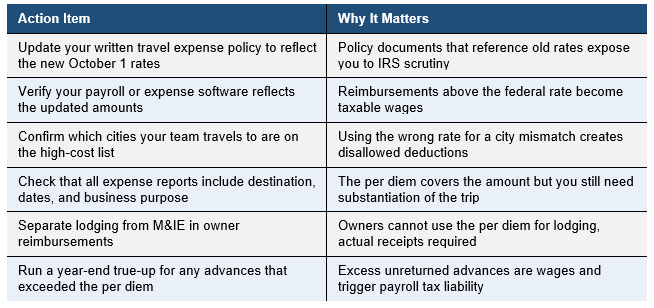
If your business sends buyers to trade shows, sales reps to retail accounts, or ops personnel to distribution centers, this update is directly relevant to your year-end expense reconciliation.
Bottom Line: The IRS raised travel per diem rates October 1. If your expense reimbursement policy still references last year’s numbers, fix it now before year end creates a payroll tax problem or a disallowed deduction on audit.