



On August 6, 2026, the IRS released Fact Sheet FS-2026-13, an updated and expanded set of FAQs on the qualified overtime compensation deduction created by the One Big Beautiful Bill Act. The update supersedes the January guidance and marks the end of the 2025 transition relief period. For retail and CPG employers with hourly workforces, warehouse and distribution employees, or any worker who regularly earns overtime, this guidance has immediate compliance consequences that cannot be deferred to year-end tax preparation.
The most operationally significant change in the updated guidance is a mandatory new W-2 reporting requirement. Beginning with tax year 2026, employers must separately report qualified overtime compensation on Form W-2, Box 12, using the new Code TT. The amount reported is the total qualified overtime compensation paid during the year, which is the FLSA-required premium above the employee’s regular rate of pay. Even if the employee cannot ultimately deduct the full amount because of the deduction caps or income-based phase-outs, the employer must report the entire amount. This is not optional and there is no longer any relief for missing or incorrect entries. If an employer reports the wrong amount in Box 12 Code TT, a corrected Form W-2c must be filed and furnished to the employee.
What qualifies as overtime compensation for the deduction, and the key reporting requirements employers must follow for tax year 2026.
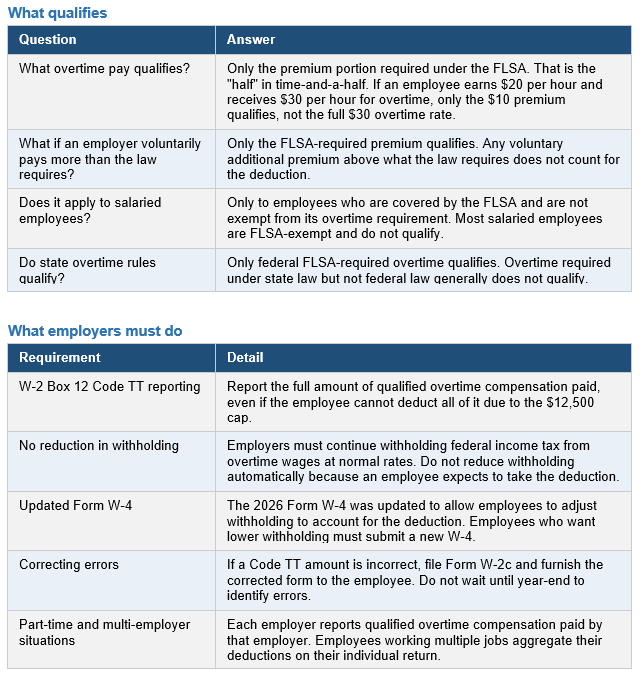
The guidance also addresses some trickier situations that retail operators with complex workforce arrangements need to understand. Healthcare and public-safety workers under alternative FLSA computation methods have specific rules for how the qualifying premium is calculated. State and local government employees who receive compensatory time off instead of cash overtime only qualify for the deduction in the year the compensatory time is actually paid out, not the year it was earned. For retail employers with both tipped and overtime-eligible workers, the two provisions operate independently and are reported separately.
If you have not already updated your payroll system to track and report qualified overtime compensation separately, do it now. The 2025 filing season gave employers a grace period because the Code TT box did not exist yet and the IRS did not require separate reporting. That grace period is over. If your payroll provider has not automatically added this feature, contact them directly and ask when the Code TT reporting will be available. Do not assume it has been handled.
Bottom Line: Tax year 2026 W-2s must include qualified overtime compensation in Box 12 using Code TT. There is no transition relief this year. Update your payroll system, brief your payroll team, and confirm the reporting is in place before year-end becomes a scramble.