



Labor is consistently the largest operating cost for retail and warehouse operations, frequently representing 25% to 40% of total operating expense depending on the business model and level of automation. Despite its scale, labor cost management in many organizations is reactive rather than strategic — driven by immediate staffing needs rather than structured analysis of productivity, scheduling efficiency, and the trade-offs between permanent and flexible workforce models.
The first step toward effective labor cost management is establishing a clear set of productivity metrics: units processed per labor hour in the warehouse, revenue per store labor hour in retail, and order fulfillment cost per unit in e-commerce fulfillment operations. Without baseline productivity measures, it is impossible to evaluate whether labor spend is generating appropriate output — or whether inefficiencies are embedded in current operations that have never been formally quantified.
Chart: Labor cost as % of revenue by operation type — benchmarks and optimization opportunity estimates.
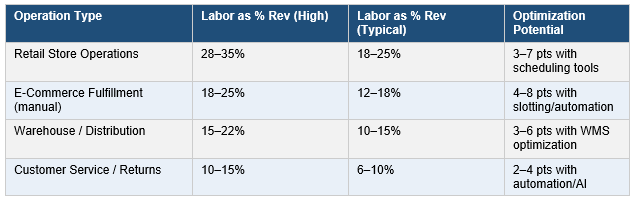
Scheduling efficiency is one of the highest-return labor cost levers available to retail operators. Many businesses over-staff during predictably slow periods and under-staff during peak hours — not because of intent, but because of scheduling systems that do not match labor deployment to traffic and transaction volume patterns. Demand-driven scheduling tools that align staffing levels with historical sales patterns can reduce labor cost as a percentage of revenue by 2 to 5 percentage points without any reduction in service levels.
The workforce mix decision — the ratio of full-time to part-time to temporary and contract labor — is a financial decision as much as an operational one. Full-time employees carry benefits costs that typically add 20% to 30% on top of base wages. Flexible staffing models that rely on a larger proportion of variable-hour workers can reduce benefits burden and improve labor cost variability, though they introduce their own challenges around training consistency, retention, and operational quality. Finance teams should model the all-in labor cost of different workforce compositions before treating the current mix as fixed.
Bottom Line: Labor optimization is not about paying people less — it is about deploying labor where and when it generates the most value, and measuring whether it actually does.