



Tariffs are inherently unpredictable — driven by geopolitical developments, domestic policy priorities, and trade negotiations that can shift rapidly. Finance teams that treat tariff rates as a fixed input in their models are setting themselves up for unpleasant surprises. Best practice is to treat tariffs as a key variable and build structured scenario analysis into the planning process.
A common framework is to model at least three scenarios — typically a base case, a moderate increase (around 10% to 15%), and a severe case (25% or more) — and evaluate the downstream impact on gross margins, EBITDA, and cash flow under each. This type of sensitivity analysis helps leadership teams understand threshold points where pricing or sourcing changes become financially necessary.
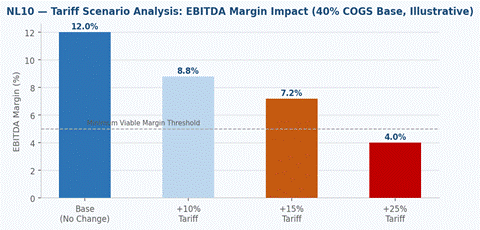
Chart: EBITDA margin impact under four tariff scenarios on a 40% COGS cost structure base.
To illustrate: a company operating with a 40% cost of goods structure could see EBITDA decline by 3 to 5 percentage points under a 10% tariff increase if no mitigating actions are taken. At typical revenue multiples, that compression has a meaningful impact on enterprise value — which matters both for private equity-backed businesses and owner-operated companies considering future transitions.
Finance leaders should integrate tariff scenario outputs directly into budgeting, quarterly forecasting, and pricing review processes. Procurement and finance teams should be aligned on the assumptions being used and update models as the policy environment evolves. Leaving tariff exposure out of forward-looking financial communication creates credibility risk when results diverge from plan.
Bottom Line: Tariff risk should be actively modeled and communicated — waiting for policy stability before building scenarios is not a defensible planning approach.