



The One Big Beautiful Bill Act made two simultaneous and offsetting changes to charitable contribution deductions that affect retail and CPG business owners and their individual tax situations in ways that are not yet widely understood. The first change creates a new benefit: taxpayers who take the standard deduction rather than itemizing may now deduct up to $1,000 in charitable contributions for single filers or $2,000 for married couples filing jointly. This is a meaningful change because the combination of the higher standard deduction, the SALT cap, and the loss of personal exemptions under the TCJA had pushed the majority of American taxpayers out of itemizing and into the standard deduction, eliminating the tax benefit of charitable giving for the many millions who no longer had enough deductions to make itemizing worthwhile. The non-itemizer charitable deduction restores some tax benefit for charitable giving for this large population of taxpayers.
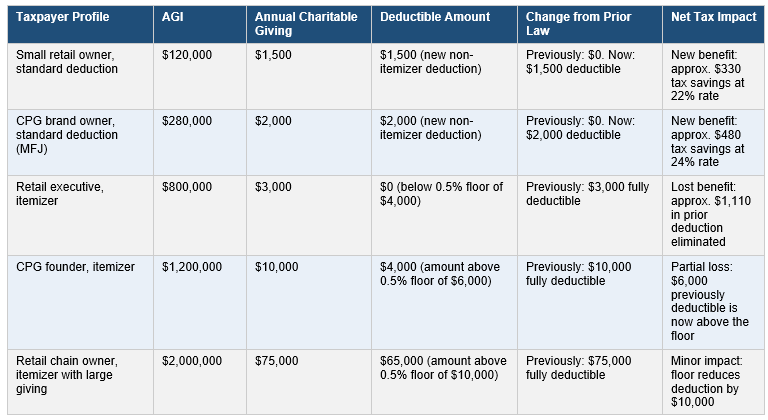
The second change imposes a new restriction: taxpayers who do itemize their deductions may only deduct charitable contributions to the extent that total contributions exceed 0.5% of adjusted gross income. This floor effectively creates a threshold below which charitable contributions generate no deduction at all, even for itemizers. At $500,000 of adjusted gross income, the floor is $2,500. At $1,000,000, the floor is $5,000. Any charitable giving below the floor produces no tax benefit, which changes the planning calculus for donors who give modest amounts relative to their income and who had previously assumed that every dollar given to charity generated a proportionate federal tax deduction.
Chart: Charitable deduction impact under the new OBBBA rules for retail and CPG business owners at various income and giving levels.
The non-itemizer deduction is partially refundable for lower-income taxpayers, which extends its reach to business owners and employees who have modest federal tax liability but still engage in charitable giving. For retail business owners who are transitioning to lower income years, winding down business activity, or in a year with large deductible expenses that reduce taxable income significantly, the partially refundable nature of the deduction means that some tax benefit may be available even in low-liability years. The specific refundability mechanics require computation against the individual’s tax situation and should not be assumed without calculation.
The planning implications run in several directions. For itemizers with giving levels near the 0.5% floor, bunching strategies, where two or more years of charitable giving are consolidated into a single tax year to push the total above both the floor and the standard deduction comparison point, become more mathematically valuable. Donor advised funds are the most common vehicle for implementing a bunching strategy, allowing the donor to take the full deduction in the year of the contribution to the fund while distributing grants to charities over multiple years at their discretion. For retail and CPG businesses with community giving programs and cause-related marketing arrangements, the new rules also affect the deductibility of certain contributions that are tied to business promotion, which should be reviewed separately under the ordinary and necessary business expense framework rather than the charitable contribution rules.
Bottom Line: The OBBBA changed charitable deduction rules in opposite directions for itemizers and non-itemizers simultaneously. Small business owners and employees who take the standard deduction now have a deduction they did not have before. High-income itemizers with modest giving may have lost a deduction they assumed was automatic. Both groups deserve an updated conversation with their tax advisor before the year ends.