



The One Big Beautiful Bill Act created two new income deductions for workers that directly affect how retail and CPG employers manage payroll, communicate with their workforce, and structure overtime scheduling. The first is a deduction of up to $25,000 for qualified tip income, available to employees who receive tips in industries where tipping is customary. The second is a deduction for the premium portion of overtime pay, capped at $12,500 for single filers and $25,000 for married filing jointly. Both provisions apply to tax years 2025 through 2028 and phase out at $150,000 in modified adjusted gross income for single filers and $300,000 for joint filers. Neither deduction is taken by the employer. The employee claims it on their individual tax return. But the employer has to do several things correctly before that can happen.
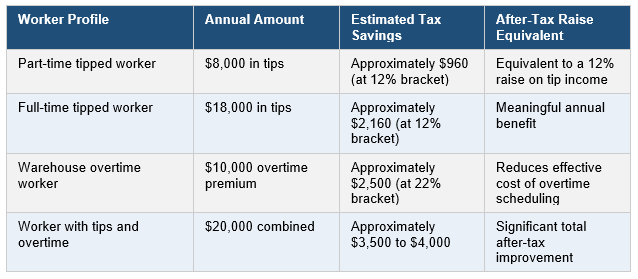
The most important employer action is making sure payroll systems correctly identify and separately report qualifying tip income and overtime premium pay. These amounts need to show up on the employee’s W-2 in a way that supports their ability to claim the deduction. Starting with 2026 W-2s, qualifying overtime compensation must be reported in Box 12 using Code TT. If your payroll system has not been updated to handle this, it needs to be. Separately, employees who are not aware of these deductions will not claim them, which is both a missed financial benefit for your workforce and a missed retention and recruiting opportunity for your business. A tipped retail worker who earns $18,000 in tips can potentially save over $2,000 in federal taxes this year. That is a meaningful benefit and your employees should hear about it from you.
After-tax income impact of the tip and overtime deductions for common retail workforce profiles.
The overtime deduction only applies to the premium portion of overtime pay, which is the additional half above the regular hourly rate. An employee earning $20 per hour who receives $30 per hour for overtime can only deduct the $10 premium, not the full $30. Employers need to make sure their payroll systems can separately identify and track this premium amount so employees have the documentation they need at tax time. Update your systems, brief your HR team, and then communicate the benefit to your workforce directly. The employees who find out about this from you trust you more. The ones who find out at tax time from someone else wonder why you did not tell them.
Bottom Line: The tip and overtime deductions are real tax benefits for your hourly workforce. The compliance obligations land on you. Update your payroll system, add Box 12 Code TT reporting for overtime, and communicate the benefit to your team before they figure it out on their own.