

Overbuying Inventory: The Hidden Cash Trap
The inventory that felt like safety stock last fall is quietly strangling your cash flow this spring.


Overbuying inventory is one of the most common — and most expensive — financial mistakes in retail and CPG. The decision to buy too much typically feels prudent at the time: demand signals are positive, lead times are uncertain, and the cost of a stockout seems worse than the cost of carrying a little extra. But excess inventory is not free. It consumes working capital, generates carrying costs, creates markdown pressure, and obscures profitability problems that would otherwise be visible in the income statement.
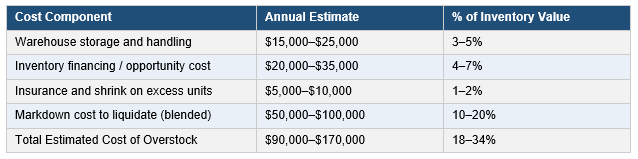
The true cost of excess inventory is almost always underestimated because most operators calculate it incompletely. The visible costs — storage fees, insurance, and handling — are the beginning of the analysis, not the end. The more significant costs are the opportunity cost of the capital tied up in unsold goods, the margin compression from eventual clearance pricing, the administrative burden of managing aged inventory, and the risk of product obsolescence or quality degradation if goods sit in storage too long.
Chart: Total cost of excess inventory — visible vs. hidden cost components on a $500K overstock position.
The structural causes of chronic overbuying are usually organizational rather than analytical. When sales teams are rewarded for revenue without accountability for inventory levels, when buyers are not measured on sell-through rates, or when the finance function is not integrated into assortment planning decisions, the incentive structure systematically biases the business toward over-commitment. Solving the problem requires changing the accountability framework, not just improving the forecast.
Finance leaders should track days inventory outstanding and inventory-to-revenue ratio monthly, flag positions that exceed 90 days on hand for active disposition planning, and ensure that assortment planning decisions are reviewed against working capital capacity before purchase orders are placed. The goal is not to minimize inventory, it is to hold the right amount at the right time, with a clear plan for what happens if demand falls short of the plan.
Bottom Line: Excess inventory is not a warehouse problem. It is a working capital problem that shows up first in the balance sheet and eventually in the income statement.