



One of the most significant tax advantages of the S-corporation structure is that distributions paid to shareholders are not subject to self-employment tax or FICA, while wages paid to shareholder-employees are subject to payroll taxes. For a profitable small retail or CPG business, this creates a powerful incentive to minimize the salary component and maximize distributions, because every dollar shifted from wages to distributions saves the owner 15.3% in FICA on amounts below the Social Security wage base and 2.9% on amounts above it. The IRS is fully aware of this incentive and requires that S-corporation owner-employees who provide more than minor services to the business pay themselves a reasonable salary before taking any distributions.
The reasonable compensation standard is not defined by a specific formula. The IRS uses a facts and circumstances test that considers the duties performed, the time and effort contributed, comparable salaries for similar positions in the same industry and geographic market, the qualifications of the owner, and the economic condition of the business. For a retail store owner who works full-time in the business, the IRS expects a salary commensurate with what a hired manager or executive in that role would earn in the open market. Paying a $30,000 salary while taking $300,000 in distributions from a profitable retail business is a position that is very difficult to defend in an audit.
Chart: Illustrative FICA tax savings from S-corporation distributions vs. wages, and the IRS audit risk at various salary-to-distribution ratios.
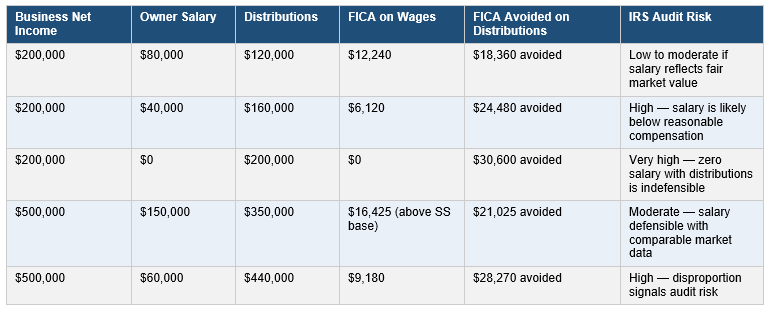
When the IRS successfully recharacterizes distributions as wages in an audit, the consequences are significant. The business owes both the employer and employee share of FICA on the recharacterized amount, plus interest and penalties. The owner owes additional income tax on any amounts that shift the effective rate upward, plus interest and penalties. The combined exposure can easily exceed the original FICA savings by a factor of two or three when penalties and multi-year interest accumulate. The correct approach is to document a defensible reasonable compensation amount at the beginning of each year, supported by comparable market data from sources such as the Bureau of Labor Statistics, industry surveys, or a compensation study prepared by the CPA.
Bottom Line: The salary-to-distribution split in an S-corporation is one of the most scrutinized issues in small business tax. Set the salary at a defensible market rate, document the basis for it, and take distributions on top of that. The FICA savings are real and legal. The IRS only objects when the salary is not reasonable.