


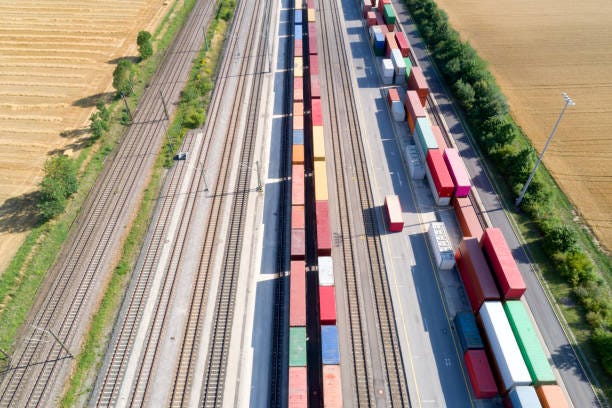
Rail freight is frequently overlooked by retail and CPG operators — particularly smaller businesses that default to over-the-road trucking for most domestic transportation. For long-distance, high-volume shipments with predictable timing requirements, however, rail and intermodal transportation can provide substantial cost savings relative to trucking, especially given the sustained elevation in trucking rates.
Rail is generally more fuel-efficient and carries a lower per-unit cost than long-haul trucking for large-volume movements. Companies moving inventory from West Coast ports to inland distribution centers — a very common flow for retail importers — may reduce transportation costs by 10% to 30% depending on route, volume, and specific lane economics.
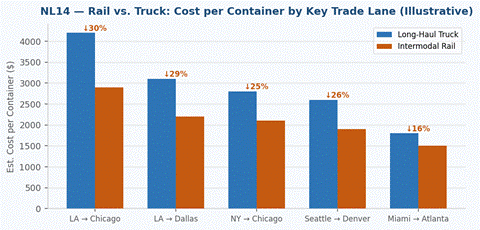
Chart: Estimated cost per container — long-haul truck vs. intermodal rail across five major domestic trade lanes.
The trade-off is speed and scheduling flexibility. Rail transit times are longer and less adaptable than over-the-road options, which makes it less suitable for urgent replenishment or highly seasonal merchandise requiring tight timing. For stable, forecastable freight flows — such as replenishment of core inventory to regional distribution centers — it can be an effective and cost-efficient option.
Rail pricing also tends to be more stable over time than spot trucking rates, which improves budgeting accuracy. Operators that have developed strong forecasting disciplines and inventory planning capabilities are generally best positioned to take advantage of rail effectively — since poor planning tends to force companies into more expensive expedited options regardless of mode.
Bottom Line: Rail freight is not the right solution for every shipment, but used strategically it can become a meaningful cost control lever for operators with predictable freight flows.