



If you sell into grocery, mass, or specialty retail, your retail partners are almost certainly taking deductions from your invoices. Some of those deductions are legitimate promotional discounts you agreed to, co op advertising fees, volume allowances. A meaningful portion of them are not. Industry benchmarks suggest that 10 to 40% of retailer deductions are invalid, duplicate, or preventable. For a $10 million brand, that is between $80,000 and $320,000 in disputed charges sitting in your accounts receivable most of it never recovered.
Total retail deductions typically represent 5 to 15% of gross sales for CPG brands. For a mid size brand doing $10 million in gross sales, that means roughly $800,000 in deductions leaving the business every year. Even at the low end of the invalid deduction range say 10% that is $80,000 in charges you should not be paying. At 40%, it is $320,000. That is real margin leaving your business because nobody is fighting for it.
The accounting treatment matters here too. Deductions that you are disputing are not business expenses and should not be written off. They are contested receivables. The correct treatment is to maintain them in a separate disputed deductions receivable account until the dispute is resolved either the retailer reverses the deduction, you negotiate a settlement, or you make a deliberate decision to write it off as uncollectable. The distinction affects both your income statement and your cash flow projections, and it affects your tax return if the write off is treated as a bad debt.
Deduction Recovery Rates by Dispute Method
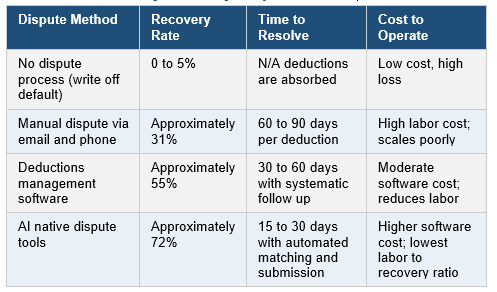
The math on investing in a deductions management system is usually straightforward. If your brand is doing $10 million in gross sales and your deductions run at industry average, improving your recovery rate from 31% (manual) to 55% (software) on $800,000 in annual deductions means recovering roughly $192,000 more per year. A deductions management platform typically costs $20,000 to $60,000 annually. The payback period is often measured in weeks, not years.
The disputes that are most recoverable are also the most tedious to fight manually: short shipment claims where your BOL shows full delivery, promotional deductions taken for promotions the retailer did not actually run, duplicate deductions for the same invoice, and deductions taken without a corresponding purchase order or promotional authorization. These are not complicated disputes. They are paper intensive disputes that systems handle better than people do.
Bottom Line: If your brand is writing off retailer deductions as a cost of doing business without disputing them, you are making a deliberate choice to give away margin. Review your deduction aging report this week. Identify what percentage are being disputed and what your recovery rate is. If the answer is ‘we don’t track that,’ you have found a cash flow problem that is hiding in plain sight.