



Sales tax compliance has never been static, but 2026 has been a particularly active year for state-level changes that directly affect retail and CPG operators. New exemptions, eliminated thresholds, revised nexus rules, and new product registration requirements have taken effect across multiple states, and each one carries its own effective date and enforcement posture. The gap between what the law now requires and what many businesses are actually doing has grown larger this year than at any point since the 2018 Wayfair decision established economic nexus.
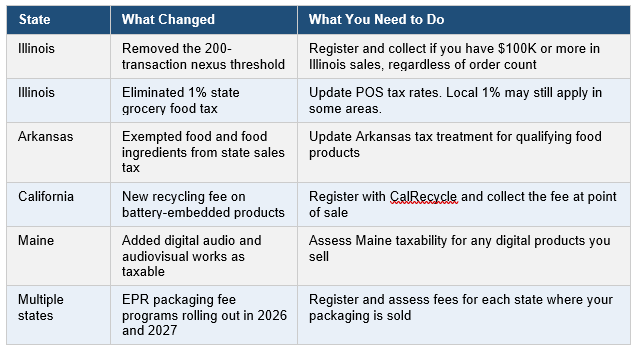
The most significant structural change is in Illinois, where the state eliminated the 200-transaction threshold from its economic nexus standard effective January 1, 2026. Before this change, a seller could avoid Illinois collection obligations by staying under 200 transactions even if they exceeded $100,000 in Illinois sales. That option is gone. If you have $100,000 or more in Illinois sales, you must register and collect, full stop. This change alone pulls a meaningful number of DTC brands and B2B sellers into Illinois compliance for the first time. California added a new recycling fee on battery-embedded products that requires registration with CalRecycle and fee collection at the point of sale. Arkansas exempted food and food ingredients from state sales tax. Maine added digital audio and audiovisual products to its taxable category.
Key 2026 state sales tax changes and the action required for retail and CPG operators.
The most common mistake operators make with sales tax is treating compliance as something they set up once and leave alone. The law changes every year in every state, and automated sales tax software updates on its own schedule, which often lags the actual effective date of new rules. Your responsibility for compliance does not pause during that lag. Conduct a systematic review of your current registrations against the 2026 changes, and confirm that any automated tools you use have applied the new rates and rules correctly.
Bottom Line: Sales tax compliance is a moving target and it moved again this year. The changes that took effect January 1, 2026 are already creating exposure for businesses that have not updated their processes. Review now, not after an audit notice.