



Most retail operators are reasonably comfortable with sales tax on a standard transaction. Product goes to the customer, tax is collected at the register, and the state gets paid. Where the compliance breaks down is in the transactions that are not standard: the return, the gift card redemption, the loyalty program reward, the promotional discount. These are common daily events in retail, and each one has sales tax implications that vary by state.
Returns are the most frequent issue. When a customer returns merchandise, they are entitled to a refund of the sales tax they paid on the original purchase. You collect that tax back from the state through a credit on your next sales tax return, or in some states through a refund claim. The complication arises when the return is made in a different period than the original sale, when it involves a gift receipt with no original receipt, or when partial returns happen on mixed taxable and non taxable purchases. Most retail POS systems handle straightforward returns correctly. The edge cases often go wrong.
Gift cards create a different issue. No sales tax is due at the time of gift card purchase because no transfer of goods has occurred. The tax is collected when the gift card is redeemed for merchandise. The tax is based on the taxable selling price at the time of redemption, not the face value of the card. When a gift card is partially redeemed, the tax applies only to the portion redeemed. When a gift card is never redeemed, it becomes subject to unclaimed property (escheatment) rules in most states, which is a separate compliance obligation entirely.
Sales Tax Treatment Across Common Retail Scenarios
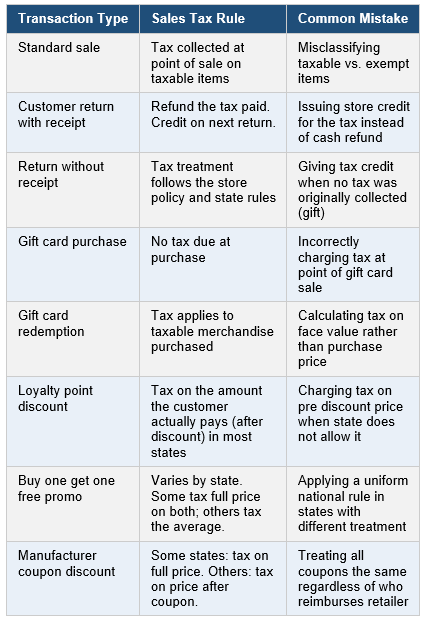
Multi state retailers face the most complexity because the rules on promotions, coupons, and loyalty programs are not uniform. In some states, sales tax applies to the full pre discount price when a coupon is reimbursed by a third party (like a manufacturer). In others, the taxable price is the amount the customer actually pays. The Streamlined Sales Tax Project has worked to harmonize many of these rules among member states, but not all states participate and even member states have exceptions.
The audit exposure here is real. Sales tax auditors are well trained to look at these scenarios because they know most retailers handle them inconsistently. A state audit that identifies systematic under collection on promotional transactions can result in liability for multiple years of back taxes, interest, and penalties on a volume of transactions that makes the total exposure significant.
Bottom Line: Sales tax compliance in retail is not just about the standard transaction. It is about every edge case that happens every day: the return, the gift card, the promo. Review your POS configuration and your policies for these scenarios with your sales tax advisor, not your income tax CPA, who may not specialize in this area.