


If you sell across state lines and have been tracking sales tax nexus based on both revenue and transaction count, you need to update your compliance model. As of August 1, 2026, seventeen states eliminated the 200 transaction economic nexus threshold. These states now use only the $100,000 annual revenue threshold to determine whether a remote seller must collect and remit sales tax.
This is actually good news for small volume sellers. If you have been required to register and collect in a state solely because you crossed 200 transactions at low dollar amounts, you may no longer have nexus there. A seller doing 250 small transactions totaling $40,000 in one of these states no longer has a filing obligation. That is a meaningful simplification for businesses with a lot of small ticket online orders that happened to cross the transaction threshold before reaching significant revenue.
The seventeen states that eliminated the transaction threshold as of August 1, 2026 include California, Illinois, Indiana, and Washington, among others. For each of these states, your nexus is now determined entirely by whether your annual sales into that state exceeded $100,000. Review your current registrations and consider whether deregistration is appropriate in states where you have nexus only through the transaction count.
For food and grocery retailers specifically, there are two additional state level changes that require attention. Illinois eliminated its 1% state grocery tax in 2026, reducing the sales tax on qualifying grocery items. Arkansas removed its state level food tax effective January 1, 2026. If you operate in either state, your POS system needs to reflect the updated rate for exempt food items.
Key Sales Tax Changes by State in 2026
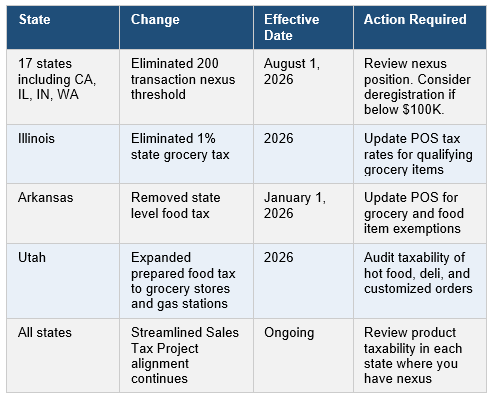
The Utah change is the one most likely to catch food retailers off guard. Utah expanded its prepared food and customized food tax to apply to grocery stores and gas stations categories that were previously treated differently from traditional food service operations. If you run a grocery store with a deli counter, a hot food station, or any customized food orders, those sales may now be subject to sales tax in Utah where they were not before.
A reminder about the practical compliance side: deregistering from a state where you no longer have nexus does not eliminate your filing obligations for the period when you did have nexus. You may owe final returns and any unpaid balances for the registration period before deregistration. Work with a sales tax specialist, not your income tax CPA, to handle deregistration properly.
Bottom Line: If you sell across state lines, pull your nexus schedule and your state registrations and review them against the August 2026 threshold changes. If you only had nexus in a state due to the transaction count, you may no longer be required to file there. If you are in Illinois, Arkan
sas, or Utah, your POS rates need to be checked today.