



If you operate retail stores in New York City, Chicago, Seattle, San Francisco, Los Angeles, or Philadelphia, you are already subject to predictive scheduling laws that require you to post employee schedules a set number of days in advance and pay a financial premium when you make last minute changes. Oregon is the only state with a statewide version of the law, and 11 cities in total have local ordinances. Michigan, Connecticut, and Rhode Island have legislation under active consideration.
Most small and mid size retailers in these markets know these laws exist. Far fewer are tracking the actual financial exposure from schedule changes, cancellations, and insufficient rest periods. The penalties are not hypothetical compliance risk. They are a recurring payroll line item that shows up in every pay period where the schedule changes after the advance notice deadline.
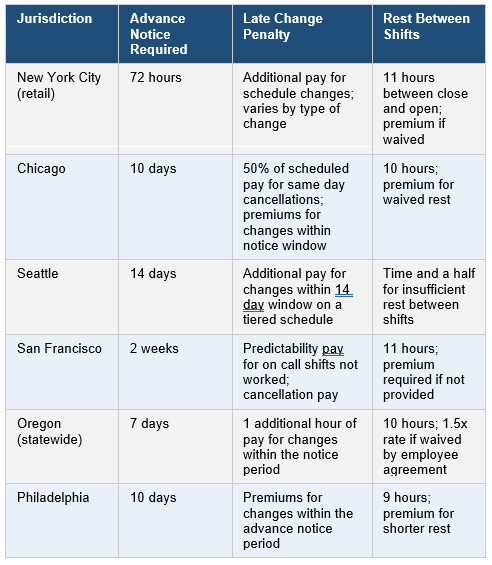
New York City’s Fair Workweek Law requires retail employers to post schedules 72 hours in advance. Chicago’s Ordinance requires 10 days. Seattle and San Francisco require 14 days. When a change is made after the required advance notice period, the retailer must pay the affected employee a premium. In Chicago, a same day cancellation triggers a payment of 50% of the scheduled shift’s pay regardless of whether the employee works it. In Seattle, employees who do not get adequate rest between shifts earn time and a half for the short rest shift. These premiums accumulate across every affected employee, every pay period.
Predictive Scheduling Penalties by Jurisdiction
The retailers who manage this best are the ones who treat predictive scheduling compliance as a financial discipline, not just an HR discipline. That means your scheduling software needs to flag any change made after the advance notice deadline and calculate the associated premium in real time. If your managers are making schedule changes manually or through a general purpose spreadsheet, you probably have no visibility into how much you are paying in scheduling premiums each period.
From a tax and accounting perspective, scheduling premiums are wages subject to payroll taxes and should be captured in your payroll system as a distinct pay code so you can track the total cost. If you are not tracking them separately, you cannot measure whether better scheduling practices would reduce the expense which is exactly what these laws are designed to incentivize.
Bottom Line: Schedule change penalties in covered cities are not a legal technicality. They are a real payroll expense. If you operate in any of the 11 covered cities or Oregon, add a distinct pay code for scheduling premiums in your payroll system, start tracking the total, and share the number with your managers. The financial incentive to give earlier notice is built into the penalties. Make sure your team can see what the premiums are actually costing.