



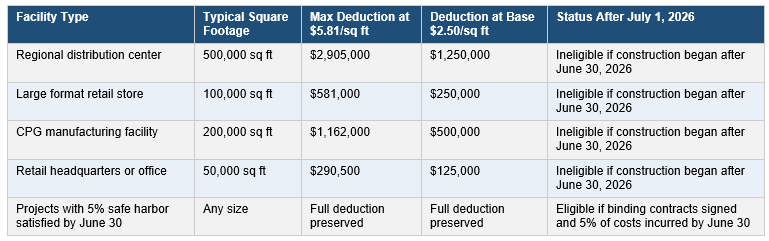
Section 179D, formally titled the Energy Efficient Commercial Building Property Deduction, has been one of the most valuable tax incentives available to commercial building owners, developers, and the architects, engineers, and contractors who design energy-efficient structures for government-owned buildings. The deduction rewarded building owners for installing energy-efficient lighting systems, HVAC equipment, and building envelope improvements that reduced total energy and power costs by at least 25% compared to applicable ASHRAE efficiency standards. The potential deduction ranged from $2.50 to $5.81 per square foot when prevailing wage and apprenticeship requirements were satisfied, meaning that a 100,000 square foot retail distribution center or flagship store meeting the highest efficiency threshold could generate a deduction approaching $581,000 on a single project.
The One Big Beautiful Bill Act set a hard termination date: Section 179D does not apply to any property on which construction begins after June 30, 2026. Projects that broke ground on or before that date preserve their eligibility, provided they satisfy all other technical, energy modeling, and certification requirements. Projects that had not yet commenced construction as of July 1, 2026, are ineligible under current law regardless of when they are completed. For retail operators, CPG manufacturers, and distribution center operators that had projects in planning stages as of the OBBBA’s enactment in July 2025, the 11-month window between enactment and the June 30 construction start deadline was the opportunity to either accelerate timelines or accept the loss of the deduction. That window has now closed.
Chart: Section 179D deduction potential for common retail and CPG facility types and the financial impact of the June 30 2026 termination.
There are two important paths that remain available. The first is the retroactive lookback study. Section 179D can be claimed retroactively for qualifying projects going back to 2006 using Form 3115, an application for change in accounting method, without requiring amended returns for prior years. Many building owners who completed qualifying energy-efficient projects during this 20-year period never claimed the deduction because they were unaware of it, their CPA did not identify it, or the certification process seemed burdensome relative to the perceived benefit. At current per-square-foot deduction values, retroactive claims on large facilities can represent hundreds of thousands of dollars in catch-up deductions available on the current-year return. Any retail or CPG company that owns commercial real estate and has completed qualifying projects since 2006 should have a CPA or specialist conduct a lookback analysis before the end of 2026.
The second path worth monitoring is legislative. Congressman Brian Fitzpatrick introduced the American Energy Dominance Act in April 2026, which includes a provision to reinstate Section 179D as a permanent deduction with no expiration date. The bill has bipartisan support and backing from North America’s Building Trades Unions but has not been enacted. For companies with projects in the planning pipeline, the smart approach is to plan as if the current law stands while monitoring the bill’s progress. Congress has extended or retroactively renewed 179D multiple times in its history, and practitioners should build contingency awareness into their capital project planning without betting on a specific legislative outcome.
Bottom Line: Section 179D ended for new projects on June 30, 2026. If you own commercial real estate that was constructed or retrofitted since 2006 and never claimed the deduction, the retroactive opportunity through Form 3115 may be the most valuable missed deduction on your balance sheet. Have your CPA conduct a lookback analysis before year end.