



US retailers lost an estimated $45 billion to shoplifting in 2024. Add employee theft and you are looking at roughly $75 billion in combined shrink losses across the industry. The per retailer picture is just as stark: shoplifting incidents increased 18% per retailer in 2024 versus 2023, and violence or threats connected to those incidents rose 17% at the same time.
Most operators think about shrink as a security problem. The better frame is a financial one. Shrink affects your gross margin directly, it affects your inventory accuracy, it affects your ability to serve customers, and it affects the tax deductions you can claim. The operator who treats it as a line item to manage not just a frustration to absorb is the one who comes out ahead on all of those dimensions.
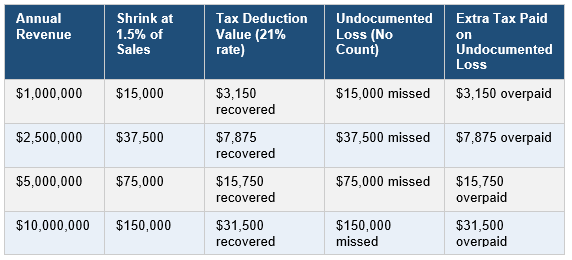
From a tax perspective, inventory losses flow through cost of goods sold when your physical inventory count reflects the missing goods. If you are not doing physical counts, your ending inventory is overstated, your COGS is understated, and your taxable income is higher than it should be. In plain terms, you are paying tax on profits you never actually made because you did not document the losses.
For losses that go beyond normal shrink a break in, a robbery, a catastrophic loss event there is a separate deduction under IRC Section 165 for casualty and theft losses on business property. That deduction is available in the year the loss is discovered, must be reduced by any insurance reimbursement, and requires documentation like a police report or insurance claim. The deduction is based on the adjusted cost basis of the property lost, not the retail value.
The Real After Tax Cost of Shrink at Different Store Sizes
The technology picture for loss prevention is shifting in a way that also changes the tax analysis. AI driven camera systems, computer vision at self checkout, and electronic article surveillance technology are now available on SaaS subscription models starting below $500 per month. Those subscription costs are fully deductible as ordinary business expenses under Section 162. The capital expense era of buying a $50,000 camera system and depreciating it over 7 years has largely been replaced by a deductible monthly subscription.
Organized retail crime is adding a layer of complexity. The NRF reports that 67% of retailers have encountered involvement by transnational organized crime groups using AI for fraud automation and coordinating theft across channels. These are not random shoplifters. They are operating like businesses, and the losses they generate often happen too fast and in too large a quantity for normal inventory shrink tracking to catch in real time.
Bottom Line: Shrink is a margin problem, a tax problem, and an operational problem and the solution to all three starts with the same thing: accurate, documented inventory counts and a disposal log that records every loss at the time it happens. The tax deduction for your losses is real, but only if you can prove the losses occurred.