



When a new retail store, CPG brand, or food service business is launched, it incurs costs before the first sale is ever made. These pre-opening expenditures fall into two categories with different tax treatment. Startup costs under IRC Section 195 are amounts paid or incurred in connection with investigating the creation of an active business, creating an active business, or beginning an active business. Organizational expenditures under IRC Section 248 for corporations or Section 709 for partnerships are the costs of forming the legal entity itself, including state filing fees, legal fees for preparing the charter or operating agreement, and accounting fees related to organizing the entity.
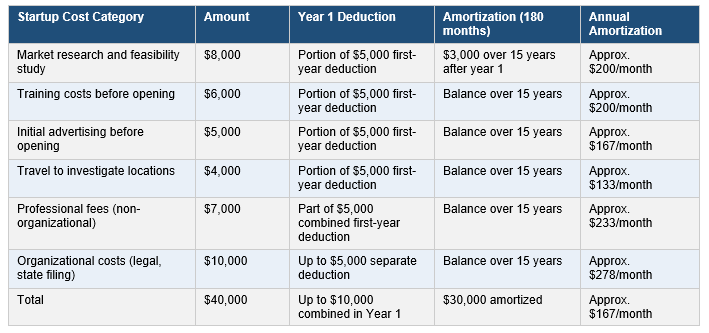
The tax treatment of both categories follows the same basic framework. The first $5,000 of startup costs and the first $5,000 of organizational expenditures can each be deducted in the year the business begins. The deductible amount is reduced dollar for dollar once total startup costs exceed $50,000 or total organizational costs exceed $50,000, completely phasing out at $55,000. Any amounts not deducted in the first year must be amortized over 180 months beginning with the month the business opens. For a retail operator spending $40,000 in pre-opening costs, the first $5,000 is deducted immediately and the remaining $35,000 is amortized at approximately $194 per month over 15 years.
Chart: Startup cost deduction and amortization schedule for a new retail business with $40,000 in pre-opening expenditures.
A critical distinction applies to costs incurred after the business officially opens. Once a retail or CPG business begins active operations, costs that would have been startup costs if incurred earlier become currently deductible operating expenses. A grand opening advertising campaign run after the store opens is an ordinary advertising expense, not a startup cost. Training costs for new employees hired after opening are currently deductible wages and training expenses. The IRS defines the beginning of the active business as the date the business begins to function as a going concern and carries on the activities for which it was organized, which for a retail business is generally the date it first opens for sales to customers.
Bottom Line: Startup costs are almost universally under tracked by new retail and CPG business owners. Many operators cannot reconstruct pre-opening expenses years later when a CPA asks for them. Keep a detailed log of every expense incurred before opening, categorize it, and retain all receipts. The $5,000 immediate deduction is available every time a new business entity is formed, making it worth claiming deliberately rather than discovering accidentally.