



The accumulated earnings tax is imposed under IRC Section 531 on C-corporations that retain earnings beyond the reasonable needs of the business for the purpose of avoiding dividend tax at the shareholder level. The tax rate is 20% applied to accumulated taxable income, which is roughly the current-year earnings and profits minus the dividends paid deduction and the accumulated earnings credit. Every C-corporation has an accumulated earnings credit of at least $250,000 ($150,000 for personal service corporations) that protects this amount of retained earnings from the tax. Retained earnings above that threshold that cannot be justified by a documented business purpose are subject to the 20% penalty tax on top of the regular corporate income tax already paid on those earnings.
For retail and CPG businesses organized as C-corporations, the accumulated earnings tax is most likely to arise when the business is highly profitable, pays minimal dividends, and accumulates significant cash or investment assets without a documented plan for using those funds in the business. The IRS looks for evidence of excess accumulation by comparing the corporation’s liquid assets to its documented business needs. Retained earnings that are earmarked for specific business purposes, such as a planned store expansion, warehouse acquisition, product line development, equipment replacement, or working capital reserves appropriate to the business cycle, are generally protected from the tax as long as the plans are genuine and documented.
Chart: Accumulated earnings tax exposure analysis for a profitable retail C-corporation.
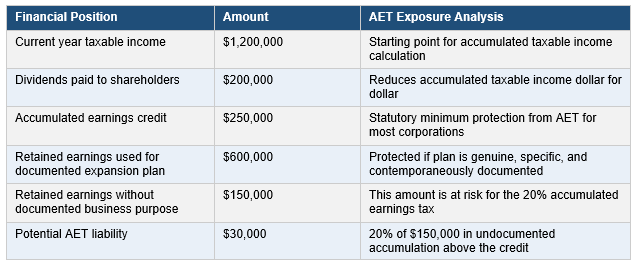
The best defense against the accumulated earnings tax is contemporaneous documentation of the business reasons for retaining earnings. Board minutes or written business plans prepared at the time of the retention decision, not retroactively, are the most persuasive evidence that accumulation is motivated by business needs rather than tax avoidance. Retail operators planning store expansions should document specific locations, construction timelines, and cost estimates. CPG companies planning product development or marketing investments should document specific initiatives and budget allocations. The specificity and contemporaneous nature of the documentation matters more than the format.
Bottom Line: The accumulated earnings tax is rarely discussed but genuinely dangerous for profitable retail and CPG C-corporations that retain cash without a documented business purpose. The solution is not to pay unnecessary dividends. It is to document the business reasons for retention in writing, at the time the decision is made.