



The Alternative Minimum Tax was originally designed to ensure that high-income taxpayers could not use legitimate deductions and credits to eliminate their federal tax liability entirely. The OBBBA increased the AMT exemption to $90,100 for single filers and $140,200 for married filing jointly for tax year 2026, with phase-out thresholds beginning at $500,000 for single filers and $1,000,000 for joint filers. Despite the higher exemption, the AMT continues to affect a meaningful number of retail and CPG business owners, particularly those with large accelerated depreciation deductions, significant incentive stock option exercises, or substantial state tax preference items.
The AMT calculation runs parallel to the regular tax calculation and disallows or adjusts several items that reduce regular taxable income. The most common AMT preference items relevant to retail and CPG operators include accelerated depreciation on real property, the depletion deduction in excess of cost basis, and certain long-term contract income. The most common AMT adjustments include the add-back of standard or itemized deductions that are allowed under the regular tax but disallowed under AMT, and the adjustment for incentive stock options exercised during the year. If the tentative minimum tax calculated under the AMT system exceeds the regular income tax liability, the difference is owed as additional tax.
Chart: AMT exposure indicators and planning benchmarks for retail and CPG business owners.
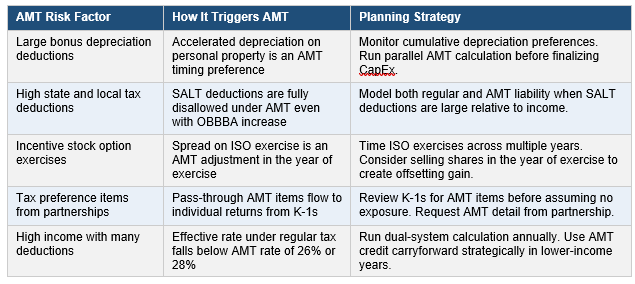
The AMT credit is one of the most underutilized provisions in the tax code for retail and CPG business owners who have paid AMT in prior years. When a taxpayer pays AMT because of timing differences rather than true preference items, the excess AMT paid generates a credit that can be used to reduce regular tax in future years when regular tax exceeds the tentative minimum tax. Business owners who paid significant AMT in years of large depreciation deductions or ISO exercises may have accumulated AMT credit carryforwards that they are not fully utilizing. Every annual tax return for a high-income retail or CPG business owner should include a review of available AMT credit and a projection of when it can be used.
Bottom Line: The AMT is a parallel tax system that does not announce itself until the return is prepared. High-income retail and CPG owners with large depreciation deductions, significant SALT, or ISO exercises should run both calculations before the tax year closes, not after.