



Section 163(j) limits how much of your business interest expense you can deduct each year. The calculation that determines that limit changed in 2022 in a way that hurt capital-intensive businesses, and the One Big Beautiful Bill Act changed it back. The difference matters. From 2018 through 2021, the limit was based on EBITDA, meaning depreciation and amortization were added back to income before applying the 30% cap. Starting in 2022, those add-backs were removed and the calculation shifted to EBIT, which produced a smaller base and a tighter limit on deductible interest. The OBBBA permanently restores the EBITDA-based calculation for tax years beginning after December 31, 2024.
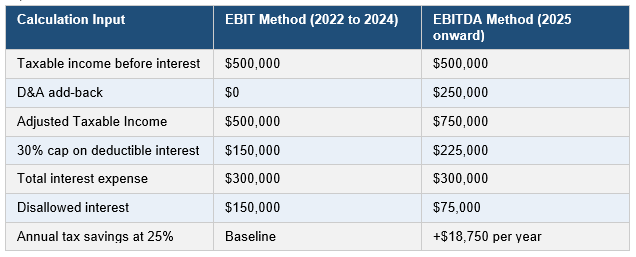
The practical difference is real money for any retail or CPG business carrying meaningful debt. A company with $500,000 in taxable income before interest and $250,000 in depreciation and amortization had an ATI of $500,000 under the old rules and has an ATI of $750,000 under the restored rules. At a 30% cap, that is the difference between $150,000 and $225,000 in deductible interest. On $300,000 in total interest expense, the EBITDA restoration turns $75,000 of previously disallowed interest into a current-year deduction. At a 25% tax rate, that is $18,750 in annual savings from a calculation method change.
EBIT versus EBITDA interest deduction comparison for a business with $300,000 in annual interest expense.
Here is the catch. The OBBBA also introduced a new rule starting January 1, 2026 that eliminates a planning strategy many businesses had been using. Previously, businesses could capitalize interest expense to inventory or assets under construction, which moved that interest outside the Section 163(j) limitation entirely. Starting in 2026, capitalized interest keeps its character as interest and stays subject to the limitation regardless of how it is booked. For businesses with significant construction or inventory financing, that change partially offsets the EBITDA restoration. Model both effects against your actual debt profile before concluding what the net result is for your business.
Bottom Line: The EBITDA restoration under Section 163(j) is a real benefit for leveraged retail and CPG businesses and worth quantifying now. Just do not forget the 2026 capitalization change. For some businesses the two effects run in opposite directions.