



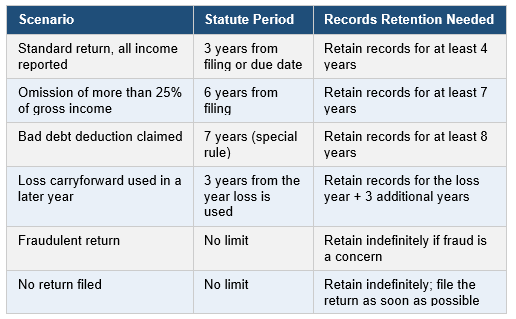
The general rule is that the IRS has three years from the date a return is filed (or its due date, whichever is later) to assess additional tax. After that, the assessment is barred by the statute of limitations. But the three-year period has important exceptions that every retail and CPG operator should know.
If you omit more than 25% of your gross income from a return, the statute extends to six years. For a retailer with $1 million in gross income who reports $700,000 whether by error or through an aggressive cash underreporting scheme the IRS has six years to assess the unreported amount and any related penalties.
If you file a fraudulent return, the statute of limitations never runs. There is no time limit on the IRS’s ability to assess tax on a fraudulent return. The same is true if you simply do not file a return for a given year the clock never starts on a year with no filing.
State statutes of limitations vary and are not synchronized with federal periods. Some states have a four-year standard period; others match federal; a few have no fixed period for certain types of underreporting. Multi-state retailers should confirm their records retention obligations in each state where they file.
Bottom Line: A three-year statute of limitations is only as good as the return underlying it. If you have unreported income or aggressive positions that could be characterized as omissions, the effective audit window may be six years or longer. Keep records longer than you think you need to.