



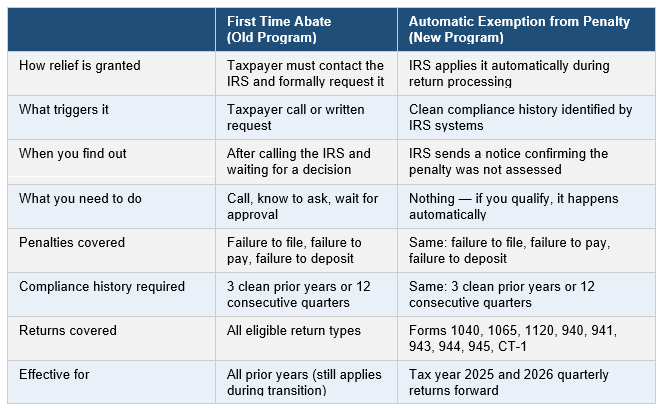
On July 8, 2026, the IRS announced a significant procedural change that most retail and CPG operators have not heard about yet. The agency is replacing the long-standing First Time Abate program with a new approach called the Automatic Exemption from Penalty. The difference is not just in the name. Under the old system, a business that filed or paid late and wanted to have the penalty removed had to contact the IRS, know to ask for first-time abatement, and wait for approval. Under the new system, if you qualify, the IRS simply does not assess the penalty in the first place and sends you a notice confirming that your compliance history protected you. You do not have to do anything.
The Automatic Exemption from Penalty program began rolling out in the summer of 2026 and applies to eligible original returns starting with tax year 2025 and 2026 quarterly returns. It covers the failure to file penalty, the failure to pay penalty, and the failure to deposit penalty, which are the three most common penalties assessed against small and mid-size retail and CPG businesses. The qualification standard is the same as First Time Abate: a clean compliance history for the three prior tax years, or 12 consecutive quarters for quarterly filers. If your business has been filing and paying on time consistently, you qualify automatically. No request needed.
How the new Automatic Exemption from Penalty compares to the First Time Abate program it is replacing.
There is an important transition period to understand. The IRS is phasing out First Time Abate gradually through the summer and fall of 2026. During the transition, some businesses that qualify for the new automatic relief may still receive penalty notices if their returns were processed before the AEP system was fully active. If you receive a penalty notice and you believe you have a clean compliance history, call the IRS and ask whether AEP, First Time Abate, or reasonable cause relief applies to your situation. Do not simply pay the penalty without checking. For eligible returns with original due dates on or after January 1, 2027, AEP will fully replace First Time Abate.
Retail and CPG businesses that do not qualify for the automatic relief because of a prior compliance issue still have options. The reasonable cause relief standard remains available and the IRS will review those requests individually. Reasonable cause exists when a failure to file or pay arose from circumstances genuinely outside the taxpayer’s control, including serious illness, natural disaster, destruction of records, or incorrect advice from a tax professional. Those requests still require documentation and a formal request, but they are a real avenue for businesses that cannot meet the clean compliance history standard.
Bottom Line: If your retail or CPG business has a clean filing and payment history and receives a late penalty notice, do not pay it automatically. The IRS may be in the process of applying AEP relief. Call and ask about your eligibility before writing a check. And if you have never heard of First Time Abate, talk to your CPA about whether your business qualifies for the new automatic version.