



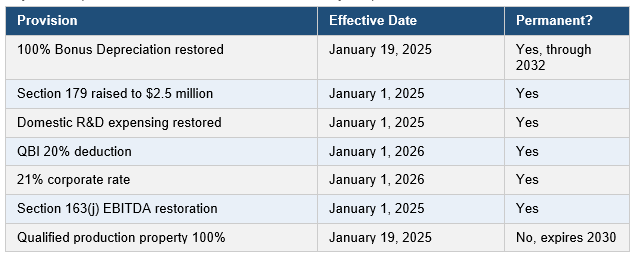
The One Big Beautiful Bill Act became law on July 4, 2025, and it changed the federal business tax landscape in ways that are real, immediate, and in most cases favorable for retail and CPG operators. The centerpiece for most businesses is the restoration of 100% bonus depreciation for qualifying assets acquired after January 19, 2025, extended through 2032. After years of watching the rate phase down to 80%, then 60%, then 40%, the full first-year deduction is back and it is permanent. If you are buying equipment, building out a store, investing in warehouse automation, or upgrading technology infrastructure, you can deduct the entire cost in the year you put it in service.
That is one piece of a larger package. The Section 179 expensing limit was raised to $2.5 million, which covers virtually any capital spending a mid-market retail or CPG business makes in a single year. R&D expensing was restored to full immediate deductibility, reversing the 2022 change that forced businesses to amortize domestic R&D costs over five years and created unexpected tax bills for product development-intensive companies. The 20% deduction for qualified business income was made permanent, which is significant for any pass-through owner who had been uncertain whether to build long-term plans around that benefit. And the 21% corporate tax rate was also made permanent, finally giving C-corporations the rate certainty they needed for meaningful planning.
Key OBBBA provisions, effective dates, and whether they are permanent.
None of these benefits are automatic. You have to claim them, structure for them, and in some cases file amended returns to recover what the old rules cost you. Businesses that have not modeled how bonus depreciation changes their capital spending strategy, or that have not evaluated whether to amend prior returns for R&D amortization recovery, are leaving real money on the table. Many of the opportunities have specific construction start dates, filing windows, or planning deadlines. The longer you wait, the more of them close.
Bottom Line: The OBBBA is not background information. It is an active set of tax benefits that are already in effect. If your advisor has not walked you through how each provision applies to your specific business, that conversation is overdue.