


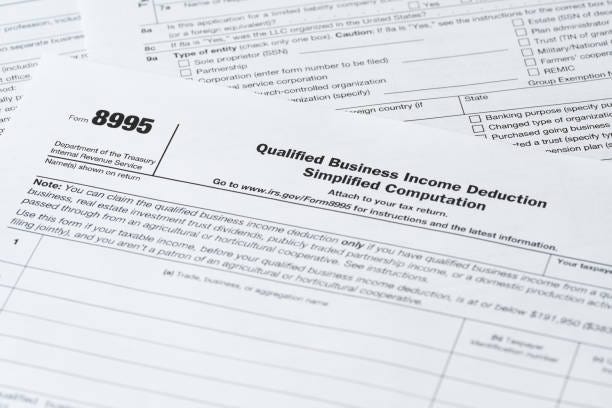
The Qualified Business Income deduction under Section 199A allows owners of pass-through businesses, including S-corporations, partnerships, limited liability companies taxed as partnerships, and sole proprietorships, to deduct up to 20% of their qualified business income before calculating their individual income tax liability. The OBBBA made this deduction permanent, removing the uncertainty that had made long-term tax planning around it difficult since its introduction under the Tax Cuts and Jobs Act of 2017. For the vast majority of independent retail operators, small and mid-size CPG brands, distributors, and food service businesses organized as pass-through entities, the permanent QBI deduction is the single most valuable tax provision in the current code.
The mechanics of the deduction are straightforward at lower income levels but become more complex as income increases. For taxpayers below the taxable income threshold of $197,300 for single filers and $394,600 for married filing jointly in 2026, the deduction is generally 20% of qualified business income, limited to 20% of ordinary taxable income before the deduction itself. For taxpayers above those thresholds, the deduction becomes subject to W-2 wage limitations, unadjusted basis limitations, and the specified service trade or business exclusion, which eliminates the deduction entirely for certain professional service businesses once income exceeds the phase-out range.
Chart: QBI deduction illustrative value by income level and business structure for retail and CPG pass-through operators.
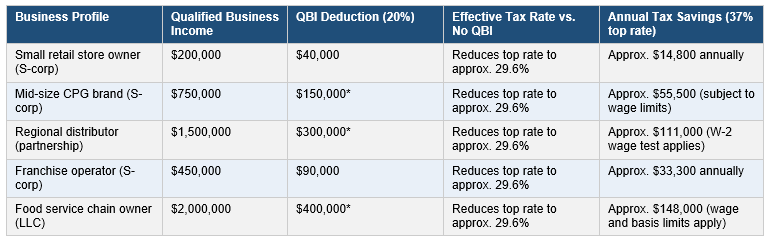
The W-2 wage limitation is the primary constraint that affects mid-to-large pass-through businesses. Above the income threshold, the QBI deduction is limited to the greater of 50% of W-2 wages paid by the business or 25% of W-2 wages plus 2.5% of the unadjusted basis of qualified property. For retail and CPG businesses with large hourly workforces and significant capital assets, the wage limitation is frequently not binding because the 50% of W-2 wages test generates a substantial allowable deduction. For leaner businesses with low payroll relative to income, the limitation can significantly reduce or even eliminate the deduction, making payroll structure decisions a meaningful tax planning lever.
With permanence now established, several planning strategies become more actionable. Business owners above the income phase-out should model the impact of accelerating W-2 wages through bonus payments before year end to increase the wage base and expand the allowable deduction. Owners near the phase-out threshold should evaluate income timing strategies, including deferral of year-end invoices or acceleration of deductible expenses, to stay within the full-deduction range. Owners evaluating whether to remain in a pass-through structure or convert to a C-corporation should now run a multi-year model that incorporates the permanent QBI deduction against the 21% corporate rate, because the permanence of both provisions changes the break-even analysis in ways that prior planning did not reflect.
Bottom Line: The permanent QBI deduction is worth up to 7.4 percentage points of effective rate reduction on pass-through business income. At the income levels typical of the retail and CPG operators who read this newsletter, that is real money. If you have not reviewed your W-2 wage structure, income timing strategy, and entity structure since the OBBBA was enacted, the conversation with your CPA is overdue.