


For most of the past decade, self-checkout was treated as an inevitability. Retailers invested heavily in the kiosks, reduced cashier headcount, and presented the technology to shareholders as a durable labor cost reduction. Consumers were told it was faster and more convenient. It was neither consistently true in practice, and the financial consequences of that miscalculation are now showing up on income statements across the industry. In 2026, the rollback is no longer quiet. It is one of the most visible operational reversals in retail in a generation, and it is being driven by a combination of shrink losses, customer frustration, new legislation, and a hard look at the unit economics that the original business case overlooked.
The financial case against self-checkout is anchored in shrink. Research consistently shows that theft rates at self-checkout are significantly higher than at staffed lanes, a result of both intentional shoplifting and what the industry calls “sweet hearting,” where unscanned items are placed in the bag alongside scanned ones, sometimes accidentally and sometimes not. Walmart reportedly lost nearly $6.5 billion to inventory theft and scanning errors in a recent reporting period, with self-checkout contributing disproportionately to that figure. A November LendingTree survey of 2,000 U.S. consumers found that 31% of Generation Z shoppers admitted to shoplifting at self-checkout kiosks, compared to 15% of shoppers overall. Those are not rounding errors. They are material line items.
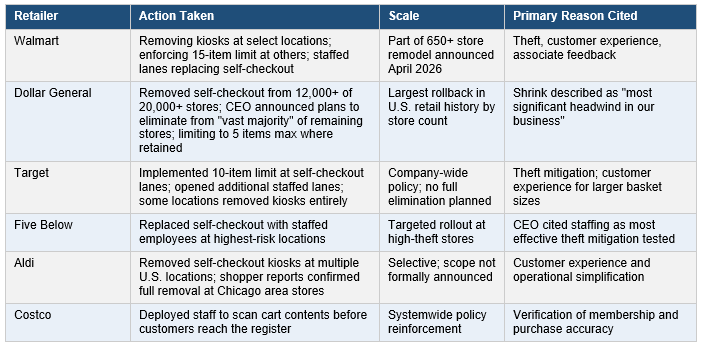
Chart: Major retailer self-checkout policy changes as of mid-2026.
The legislative environment is accelerating retailer decision making in ways that would have been difficult to predict even two years ago. Long Beach, California adopted a local ordinance in August 2025 requiring retailers to maintain at least one staffed checkout lane and an on-duty employee overseeing self-checkout use. Costa Mesa, California followed in February 2026 with a similar requirement. Seven states currently have pending legislation addressing self-checkout staffing ratios or item count limits. Ohio and New York are debating bills that would require at least one employee monitoring every three self-checkout kiosks, with daily fines of up to $100 per violation for non-compliance. For multi-state retailers managing hundreds of locations, the compliance patchwork is becoming a meaningful operational burden on top of the shrink problem.
The customer experience argument against self-checkout has been building for years but rarely made it into public corporate communications. It is making it now. Broken bagging scales, weight sensor errors, unexpected item in the bagging area alerts, age verification holds, and the absence of any employee capable of resolving these issues quickly have eroded the convenience promise that justified the original investment. Walmart’s own spokespeople now describe the return of staffed lanes as an opportunity to “offer more personalized service” and respond to “associate and customer feedback.” That is polished language for a straightforward truth: a meaningful portion of customers find the experience frustrating, and frustrated customers spend less.
The financial implication for retail operators evaluating their own self-checkout posture is more nuanced than the headlines suggest. The labor savings from self-checkout are real but were almost universally modeled without adequately accounting for the shrink offset. A retailer that saved $500,000 per year in cashier wages across a group of stores but experienced $800,000 in incremental shrink attributable to self-checkout did not save anything. It lost $300,000 and generated a customer experience problem on top of that. The correct analysis requires a store-level view of both the labor savings and the shrink impact, compared against a staffed lane scenario with its own fully loaded labor cost including benefits, scheduling overhead, and turnover expense.
For smaller retail and CPG operators watching this trend, the lesson is not necessarily to abandon self-checkout but to evaluate it honestly. The retailers pulling back are predominantly high-volume, high-traffic formats where the theft opportunity is greatest and the staffing economics of a hybrid model are achievable. A boutique specialty retailer or a smaller format grocery operator may find that a single employee monitoring two or three kiosks produces a better outcome on both shrink and customer experience than either full self-checkout or fully staffed lanes. The model matters less than the measurement. Operators who are tracking shrink by lane type, monitoring transaction accuracy, and evaluating customer satisfaction by checkout format have the data to make the right call. Those who are not should start.
Bottom Line: The self-checkout rollback is the retail industry correcting a business case that was built on incomplete math. The labor savings were real. The shrink costs were underestimated. The customer experience impact was ignored. The retailers that are coming out ahead are the ones that built the full cost model before they built the kiosk layout, and the ones pulling back now are doing so because the numbers finally demanded it.