



Pricing decisions carry more financial leverage than almost anything else a retail or CPG business can do. A 1% increase in net price with no change in volume drops entirely to gross profit. That makes pricing more powerful than a cost reduction of equal size, which usually takes real operational effort to actually deliver. And yet price increases are among the most emotionally charged and analytically difficult calls a finance team faces, because the downside is real. If volume falls far enough, the increase hurts you more than it helps you. Getting it right requires more than picking a number. It requires understanding what your customers will actually do when they see it on the shelf.
The starting point for any serious pricing analysis is an honest look at price elasticity. That is the question of how much volume you expect to lose when prices go up. In categories with strong brand loyalty and few real alternatives, elasticity tends to be low. Customers might grumble, but they keep buying, and you can move prices meaningfully without losing much. In categories where store brands are strong, where there are plenty of competitive options, and where consumers are already making decisions based on value, elasticity is much higher. Even a modest price increase can push customers toward something cheaper. Knowing where your business actually sits on that spectrum is not optional. It is the foundation of every pricing call you make.
Price elasticity model: how volume and gross profit respond to price increases under two different scenarios.
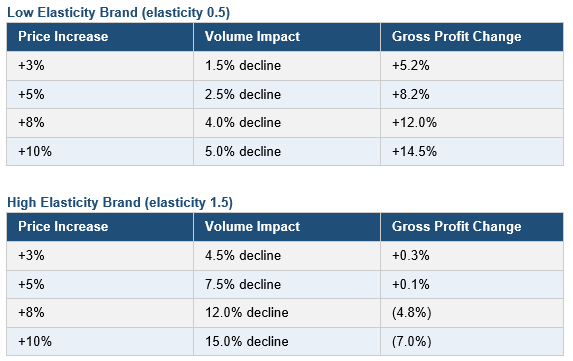
The tables tell a clear story. In a low elasticity environment, even a 10% price increase is net positive because volume holds reasonably well and the margin benefit outweighs the loss. In a high elasticity environment, an 8% increase already destroys gross profit. The math is not hard. The hard part is being honest about which situation your business is actually in, especially when there is pressure to improve margins quickly.
Beyond elasticity, a CFO thinking through a price increase is also looking at the competitive landscape, which channels are involved, and whether the timing makes sense. Price increases tied to real, publicly understood cost pressures are far easier to defend. When tariffs went up, when freight costs spiked, or when commodity prices moved significantly, retail partners and consumers understood why prices followed. Transparency helps. A specific, well-explained increase lands better than a vague ask for more margin. If you can tell a buyer that your costs went up by a measurable amount due to a specific cause and you are asking for a proportionate adjustment, that is a very different conversation.
Once you have decided to raise prices, execution is everything. Changing your list price is not the same as actually capturing more margin. Many businesses raise the list and then keep running the same promotions at the same depths, which means the net realized price barely moves at all. The increase has to flow all the way through to what the customer actually pays. That requires discipline in how promotions run going forward, how retailer allowances are negotiated, and how existing orders at the old price get managed through the transition. Finance teams should track net price realization versus list price change closely in the months after any increase. If the list went up 5% but net realized price only moved 1%, the increase did not work as planned, and you need to understand why before the next pricing cycle.
Bottom Line: A price increase only improves margins if two things happen: volume holds close enough to make the math work, and the increase actually flows through to the price customers pay. Both of those outcomes require active management. Changing the number on a price list is the easy part. Making sure it sticks is the job.