



Gross margin is one of the most important financial metrics in retail and CPG, but it is also one of the most misunderstood — largely because what constitutes a “good” gross margin varies significantly by category, channel, and business model. A 45% gross margin may represent exceptional performance in grocery and a serious problem in luxury skincare. Without category-specific benchmarks, operators have no reliable way to assess whether their current margins reflect a competitive position or a structural disadvantage.
The variation across categories reflects fundamental differences in cost structure, pricing power, competitive intensity, and channel economics. Commodity-adjacent categories — food staples, household cleaning products, basic apparel — tend to operate with thinner margins because input costs are well understood by buyers and pricing competition is intense. Categories with strong brand differentiation, limited competition, or high perceived value — premium beauty, specialty nutrition, branded footwear — command meaningfully higher margins.
Chart: Gross margin benchmarks by retail and CPG category — illustrative ranges based on industry data.
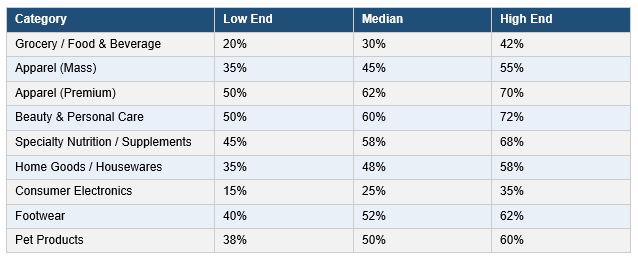
Channel mix also drives significant variation within categories. A brand selling the same product DTC and through a major retailer will typically report a 20 to 30 percentage point difference in channel-level gross margin. The retailer channel absorbs a margin allowance that reflects the retailer’s buying power, promotional requirements, freight and compliance costs, and the cost of returns. Finance teams should calculate and track gross margin by channel separately — blended margins can mask serious structural issues in one segment.
When a company’s gross margins fall below category benchmarks, the root cause is almost always one of three things: pricing that is too low relative to the cost structure, input costs that are out of line with industry norms, or a channel mix that is disproportionately weighted toward lower-margin customers. Each of these has a different solution, and identifying the correct diagnosis requires category-level benchmark data rather than general rules of thumb.
Bottom Line: Gross margin benchmarks provide the reference point that turns an internal number into actionable insight. Know where you stand relative to your category — and know why.