



Warehouse costs are one of the largest fixed expense categories for retail and CPG businesses, and they are also one of the most complex from a tax perspective. Rent, utilities, labor, equipment, racking, insurance, and technology all interact in ways that affect both your current deductions and your capitalization obligations. Getting this wrong in either direction costs real money.
The starting point is understanding which warehouse costs are currently deductible and which must be capitalized. Rent paid on a leased warehouse is fully deductible in the period it is paid or accrued. Utilities, insurance, and ongoing maintenance are also currently deductible. Labor costs for warehouse employees, including wages, payroll taxes, and benefits, are deductible in the period paid.
Where it gets more complex is equipment and leasehold improvements. Racking systems, conveyor equipment, forklifts, and automated systems are depreciable assets, not current expenses. Under the OBBBA and prior law changes, most of this equipment qualifies for bonus depreciation or Section 179 expensing, which means you can deduct the full cost in the year it is placed in service rather than depreciating it over 5 or 7 years. But the timing of when equipment is placed in service not when it is purchased or ordered determines which tax year the deduction falls in.
Warehouse Cost Tax Treatment at a Glance
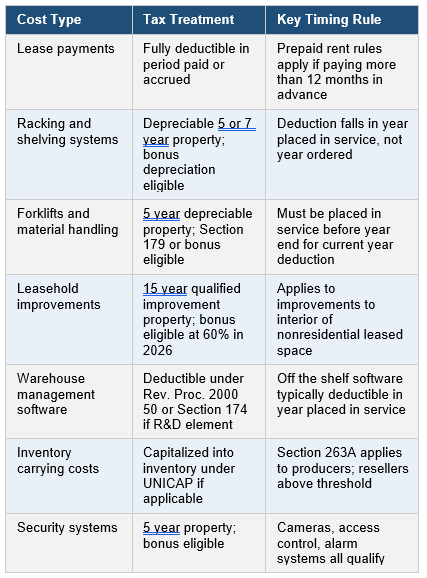
One area that catches mid size retailers by surprise is the uniform capitalization rules under IRC Section 263A. These rules require certain businesses to capitalize a portion of their indirect costs, including warehousing costs, into inventory rather than deducting them currently. If you are a producer of goods a CPG brand manufacturing its own product or a retailer or wholesaler with average annual gross receipts above the small business threshold (currently $31 million), you may be subject to these rules. The capitalized amount increases your inventory basis and flows through COGS as goods are sold rather than as a current expense.
For businesses below the Section 263A threshold, all warehousing costs are currently deductible. This is one of the reasons the small business gross receipts threshold matters businesses that cross it face higher tax complexity and often higher effective taxes because costs that were previously deductible now have to be spread over the life of the inventory.
Year end timing is important. Any equipment you plan to purchase for warehouse operations that you want to deduct in the current year must be ordered, received, and placed in service before December 31. For retailers on a fiscal year other than calendar year, the placed in service date must fall before the end of your fiscal year. ‘Ordered’ is not enough. The equipment needs to be installed and operational.
Bottom Line: Warehouse costs are a significant and often undertaxed expense category. Make sure your CPA has a full picture of your leases, equipment, and improvements, and