



Air freight is often treated as a last resort given its cost premium over ocean shipping — depending on route and product category, it can run five to ten times more expensive. But in the right circumstances, the financial case for air freight is stronger than it appears when viewed through the lens of contribution margin rather than freight cost alone.
The relevant question for finance leaders is not simply what a shipment costs, but what is the margin impact of the alternative. Stockouts on seasonal merchandise, missed retailer launch windows, or lost promotional revenue can each carry a financial cost that exceeds the freight premium by a significant margin. When viewed that way, air freight can be the less expensive option.
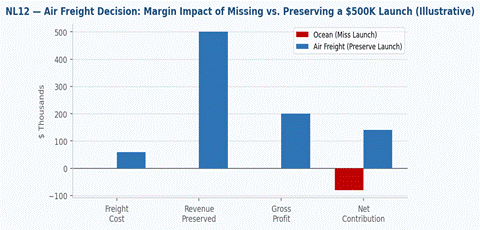
Chart: Gross profit comparison — missing a $500K launch vs. using air freight to preserve it.
Consider a beauty brand facing a delayed ocean shipment ahead of a major retail launch. Spending $60,000 in incremental air freight to protect a $500,000 sales opportunity — one that would otherwise generate positive contribution margin — is financially sound. The downstream consequences of missing the launch, including potential retailer penalties or loss of shelf placement, may be even more expensive than the freight cost itself.
Finance and operations teams should establish clear decision criteria for when expedited freight is financially justified — incorporating contribution margin, customer impact, and replacement cost — so that decisions are made consistently and based on data rather than urgency alone. A chronic reliance on air freight typically signals a deeper problem in demand forecasting or procurement planning that deserves direct attention.
Bottom Line: Air freight is expensive, but in the right scenarios it protects revenue, customer relationships, and long-term profitability.