



If you run a food, beverage, or perishable goods business, product losses are not a question of if, but when. Spoilage, expiration, contamination, and recalls are part of operating in consumer goods. The tax code treats these as real business losses, but only if they are documented correctly at the right time. Most small CPG operators and specialty retailers do not have the documentation processes in place to capture the full deduction.
Spoilage and expiration losses for businesses using an accrual based inventory system flow through cost of goods sold when the inventory is written down to zero or to its net realizable value. That means the deduction is captured when you dispose of the product or write it off on the books not when you first realize it is going bad, and not in a prior period when you purchased it. The write off needs to happen before your fiscal year closes to count in that year.
For a CPG company dealing with a product recall, the tax treatment can involve multiple expense categories. The cost of the recalled inventory itself flows through COGS as the inventory is written off. Expenses incurred to retrieve, transport, store, and destroy recalled product are deductible as ordinary and necessary business expenses in the year incurred. Legal costs related to the recall are also deductible. Costs that create a future benefit reformulation of the product, new packaging, testing protocols that improve ongoing safety may need to be capitalized.
Tax Treatment by Type of Product Loss
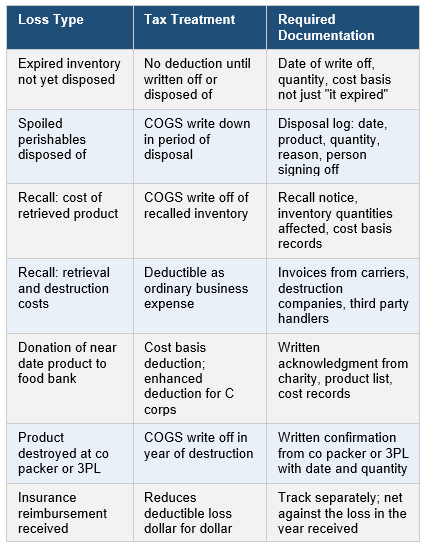
One documentation practice that separates prepared businesses from unprepared ones: a physical destruction log signed by a responsible employee or manager at the time of disposal. The IRS does not require a notarized document or a third party witness for routine spoilage, but a signed, dated log showing the product, quantity, reason for disposal, and the person who authorized and executed it creates a contemporaneous record that is nearly impossible to challenge.
For larger destruction events, particularly recalls, consider retaining a licensed destruction company that provides a certificate of destruction. This is standard practice in food and beverage, pharmaceutical, and personal care product industries, and the certificate creates an independent third party record of the destruction event, date, and quantity.
Bottom Line: Product losses are a real cost of operating in consumer goods and retail. They are also a real deduction but only if they are documented at the time they happen, not reconstructed afterward. Build the disposal log into your receiving and inventory management process now, before you need it in an audit.