



If you own a retail store, a distribution center, or a warehouse and you have been depreciating it on a 39 year straight line schedule, you are probably leaving significant tax deductions on the table. A cost segregation study is an engineering based tax analysis that breaks a commercial building into its component parts and assigns each component the shortest allowable depreciation life. The result is usually a large acceleration of deductions into the early years of ownership.
Here is how it works. When you buy or build a commercial property, the default is to depreciate the entire building structure over 39 years. But a commercial property is not one thing. It is a collection of components with different useful lives. Specialty lighting designed for product display is not the same as the structural walls. The electrical system serving point of sale equipment is not the same as the HVAC for the building shell. The retail floor covering is not the same as the concrete foundation.
A cost segregation study, performed by an engineering firm or a CPA with engineering expertise, identifies which components qualify for 5 year, 7 year, or 15 year depreciation instead of 39 years. When combined with the bonus depreciation rules under the OBBBA (60% in 2026, stepping down 20 percentage points per year), those accelerated components can generate substantial deductions in the year the study is completed even on a property you purchased years ago.
What Gets Reclassified in a Retail or Warehouse Property
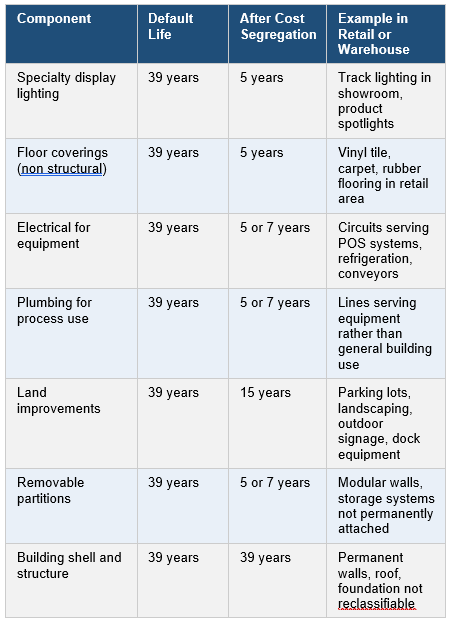
The financial impact can be substantial. A typical retail building purchase of $1 million might yield $200,000 to $350,000 of reclassified components through a cost segregation study. At a 21% corporate rate, that is $42,000 to $73,500 in accelerated tax savings brought forward from future years. At an individual rate of 37%, the savings are higher. The cost of the study itself, typically $5,000 to $15,000 depending on property size, is almost always recovered in the first year.
The study can be performed on properties you already own. A lookback study on a building purchased in a prior year can catch up all the missed accelerated depreciation in a single year through an automatic accounting method change filed with the IRS. You do not need to amend prior returns. The catch up deduction lands on your current year return.
Warehouse and distribution center owners are particularly well positioned for this strategy because these buildings tend to have large amounts of process related electrical, plumbing, dock equipment, and materials handling infrastructure that qualifies for shorter lives. The structural shell of a warehouse is simple. The equipment and systems inside it often are not.
Bottom Line: If you own commercial property and have not had a cost segregation study performed, the conversation with your CPA should happen before year end. The study pays for itself quickly, and the accelerated deductions are real money in your pocket rather than deductions spread across decades you may not even own the property.