



The cash conversion cycle (CCC) measures how many days elapse between when you spend money on inventory and when you collect cash from a sale. A shorter cycle means less working capital trapped in the business. A longer cycle means you’re financing your inventory and your customers simultaneously.
The CCC is calculated as Days Inventory Outstanding (DIO) plus Days Sales Outstanding (DSO) minus Days Payable Outstanding (DPO). If you hold inventory for 45 days, collect from customers in 30 days, but pay your suppliers in 30 days, your CCC is 45 days. You need 45 days of cash on hand just to keep the operation running at steady state.
Large retailers drive their CCC negative they collect from customers before they pay suppliers, effectively borrowing from the supply chain for free. Walmart’s CCC is consistently negative. For smaller retail and CPG operators, the goal is to shorten DIO and DPO and stretch DPO within the limits of your supplier agreements.
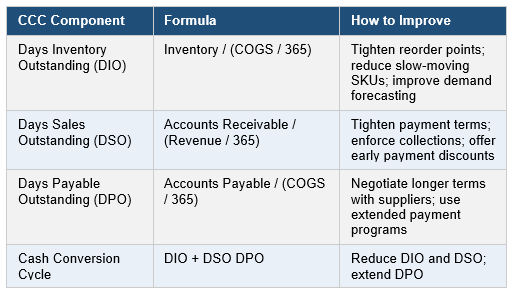
For CPG brands selling through wholesale accounts, DSO is the critical lever. Net 30 terms on paper often translate to Net 45 or Net 60 in practice. Each day of additional DSO on a $10M revenue base ties up an additional $27,400 in cash. Track it monthly.
Bottom Line: Your cash conversion cycle tells you more about your working capital needs than any single balance sheet number. If you’re feeling cash-constrained but the business is profitable, a rising CCC is often the explanation. Calculate yours quarterly.