



The federal Research and Development tax credit under IRC Section 41 is one of the most underutilized provisions available to CPG companies. Most founders assume R&D credits are for technology companies running labs with scientists in white coats. That is wrong. Formulation trials, shelf life testing, packaging performance testing, and production process improvement all qualify if the activity meets the IRS definition of qualified research.
The four part test for qualified research is: the activity must involve technological uncertainty (you do not already know the answer), it must involve a process of experimentation (trial and error, not just execution), the work must be technological in nature (relying on hard sciences, engineering, or biology), and it must have a permitted purpose (developing or improving a product or process). For a CPG brand testing new formulations, running stability studies, or optimizing a production line to improve yield, most of this work qualifies.
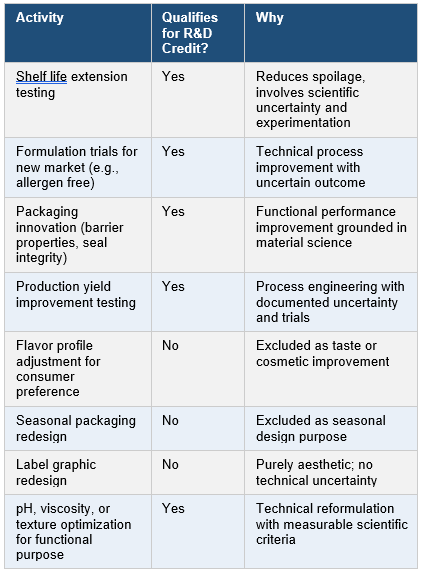
The exclusion that trips up food and beverage brands is the style, taste, and cosmetic exclusion. Activities undertaken for style, taste, cosmetic, or seasonal design purposes do not qualify. If you changed a flavor to make the product more appealing, that is excluded. If you changed a formulation to extend shelf life, improve nutritional profile, achieve gluten free certification, or reduce allergen contamination risk, that likely qualifies. The line runs between aesthetic choices (excluded) and technical performance improvements (included).
Qualifying vs. Non Qualifying CPG Research Activities
The financial impact is real. A case study from a $15 million CPG company showed $150,000 in combined federal and state R&D credits from qualifying formulation and process work. For early stage brands with less than $5 million in gross receipts and no more than 5 years of gross receipts history, the payroll tax offset provision is especially valuable: qualifying small businesses can apply up to $500,000 per year of the R&D credit against their payroll tax liability, creating a cash benefit even before the company is profitable.
The OBBBA added another layer: domestic research expenditures can now be immediately deducted in the year incurred rather than capitalized and amortized over 5 years as was required under the 2022 rules. That means a CPG brand doing qualifying R&D can both deduct the expense currently and claim a credit on a portion of it two tax benefits from the same dollars, with proper documentation.
Bottom Line: If your CPG brand is running formulation trials, shelf life studies, or production process experiments and you have not talked to your CPA about the R&D credit, you are probably leaving money on the table. The credit is available on qualifying work you are already doing. The only thing standing between you and the credit is documentation of what you tested, why you tested it, and what you learned.