


If you run a CPG brand and your gross margin looks strong on paper, there is a question worth asking before you take that number to a bank, a broker, or a potential investor: where is your trade spending showing up on your P&L? For most early stage and mid market CPG brands, the answer is the wrong place. And that means your gross margin is overstated.
Trade spending is the money CPG brands pay to retailers to support distribution slotting fees, promotional allowances, off invoice discounts, co op advertising, and display fees. For a mid size CPG brand, trade spending commonly runs 15 to 25% of gross sales. For brands in competitive grocery categories, total gross to net deductions including promotional allowances can reach 30 to 40% of gross revenue, leaving you with net revenue of 60 to 70 cents on every gross dollar.
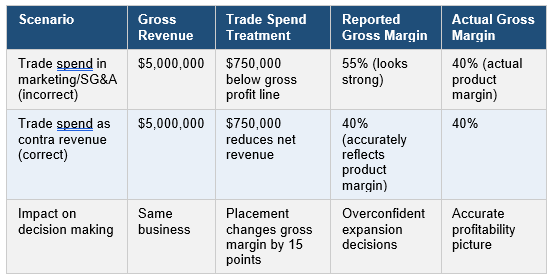
The accounting standard that governs this is ASC 606, the revenue recognition standard that applies to most businesses. Under ASC 606, payments you make to your customer (the retailer) are treated as a reduction of the transaction price. That means trade spending is contra revenue, it reduces your top line before you get to gross profit. It does not belong in marketing expense or in SG&A. When you put it there, your reported gross margin overstates what you are actually earning on the product itself.
What Happens When Trade Spending Is in the Wrong Place
Slotting fees deserve a specific mention because they involve a genuine IRS gray area. When a CPG brand pays a grocery chain $15,000 per SKU to place a new product on shelf, that payment creates a multi year benefit the shelf space for the duration of the arrangement. The INDOPCO doctrine, which governs capitalization of expenditures that create future benefits, raises the question of whether slotting fees should be capitalized and amortized rather than immediately expensed. The IRS has not issued formal guidance specifically for slotting fees, and practices vary. This is worth discussing with your CPA before you file.
The practical fix for the P&L is to work with your accounting system to create a contra revenue account structure that properly reflects trade spending above the gross profit line. This requires accruing expected trade spend monthly against gross revenue as it is earned, not after promotional invoices arrive from retailers. Most early stage brands are not doing this, which means their monthly P&L is distorted revenue looks too high early in the month and then drops sharply when deductions come in.
Bottom Line: If your gross margin looks better than your peers and you are not sure why, find out where your trade spending is sitting on your P&L before you share that margin number with anyone. Correcting the classification will lower your reported gross margin, but it will give you a number you can defend to a banker, a broker, or an acquirer and a P&L that actually helps you manage the business.