



Most business owners pick an inventory accounting method once when they open and never revisit it. That is a mistake, because the method you use determines how much of your inventory cost flows through COGS each period, which directly determines your taxable income. In an environment of rising costs, that choice can mean tens of thousands of dollars in tax difference on an identical business.
The three most common methods are FIFO (first in, first out), LIFO (last in, first out), and weighted average cost. Each one assumes a different pattern for which inventory was sold, and in times of changing prices, each produces a different taxable result.
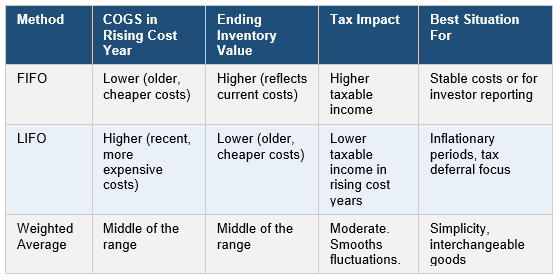
FIFO assumes the oldest inventory is sold first. In an environment of rising costs, FIFO produces higher profits on paper because the older, cheaper inventory flows through COGS while the newer, more expensive inventory stays on the balance sheet. Higher profits mean higher taxes. FIFO is required for IFRS reporting and is common among companies that report to outside investors because it often produces a balance sheet inventory value closer to current replacement cost.
LIFO assumes the most recently purchased inventory is sold first. In rising cost environments, LIFO pushes the most expensive, recently purchased inventory into COGS, which reduces taxable income. For a retailer dealing with supplier price increases or input cost inflation, LIFO has historically been a meaningful tax deferral tool. The downside is complexity: LIFO requires a LIFO reserve calculation, reduces balance sheet inventory values over time, and can trigger a large taxable event if LIFO layers are liquidated in a year when purchases fall below sales.
Weighted average cost averages all inventory costs together and applies a single per unit cost to both ending inventory and COGS. It smooths the impact of price changes and is simpler to administer than LIFO, though it provides less tax benefit in a rising cost environment.
How the Methods Compare in a Rising Cost Environment
One critical rule: once you elect a LIFO method, switching to FIFO requires IRS approval and triggers a LIFO recapture adjustment essentially, you pay tax on the accumulated LIFO reserve over a four year period. This is a significant commitment, and the decision to adopt LIFO should be made deliberately with a long term view.
There is also a specific caution for S corporations and partnerships: the inventory method elected at the entity level flows through to owners. If the entity carries a LIFO reserve that would be recaptured on a switch from S corp to C corp, or on a business sale, that is a taxable event. Retail and CPG businesses considering a sale or entity restructuring need to include the inventory method in the analysis.
Bottom Line: Your inventory accounting method is not a set it and forget it decision. It is a tax policy that should be reviewed periodically, especially when your cost environment changes. If you have been on FIFO through years of supply chain inflation and cost increases, ask your CPA whether LIFO might have been a better choice and what the math looks like going forward.