



Here is something that is going to catch a lot of retail and food service employers off guard this coming January: the One Big Beautiful Bill Act changed how tips and overtime must appear on Form W 2, and the change applies to the 2026 tax year. That means the W 2s you issue to your employees in early 2027 need to reflect a new reporting format. Many payroll systems are not there yet.
The OBBBA introduced individual income tax deductions for qualifying tip income (up to $25,000 per year) and FLSA overtime premium pay (up to $12,500 for single filers or $25,000 for joint filers). Those deductions sound great for employees. The catch is that employees can only claim those deductions if their employer reports the amounts separately and correctly on their W 2. If your W 2 does not break out qualified tips and qualifying overtime, your employees lose the deduction entirely.
The definition of qualifying overtime matters. Only FLSA required overtime counts. That is the extra half time premium on hours worked beyond 40 in a workweek under federal law. State mandated daily overtime (common in California) does not qualify. Contractual overtime that exceeds what FLSA requires does not qualify. Your payroll system needs to distinguish between FLSA overtime and non FLSA overtime, which is not a distinction most systems were built to track separately before this law passed.
There is another wrinkle for retailers who have added digital tipping at checkout in the last few years. The OBBBA’s tip deduction is tied to employees who work in occupations that have historically received tips. The IRS will define these occupations in forthcoming guidance. Employees who receive tips at a digital checkout in a retail setting where tipping was not historically customary may not qualify. If you added tipping to your POS to boost employee pay, that income may not be deductible for the employees even though it is still tip income for other purposes.
What Employers Need to Do Before Year End
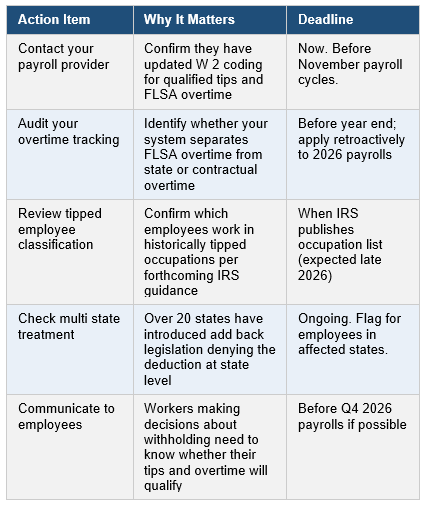
The practical consequence of getting this wrong is that your employees miss a deduction they were entitled to take. For a tipped employee earning $20,000 in qualifying tips, the missed deduction at a 22% effective rate is $4,400 in extra federal tax. That is not a small number for an hourly worker, and it is going to come back to you as an employer when employees find out their W 2 did not reflect the qualifying amounts.
The IRS issued initial guidance in January 2026 (IR 2026 10) and has provided transition relief from penalties for good faith compliance efforts in the first year. That relief will not be indefinitely available. Get your payroll vendor on the phone now, not in December.
Bottom Line: The W 2 changes from the OBBBA are live for the 2026 tax year. Call your payroll provider today and ask specifically whether they have updated for qualified tip reporting and FLSA overtime separation on W 2s. If they have not, you have a problem to solve before January. Your employees are counting on you to get this right.